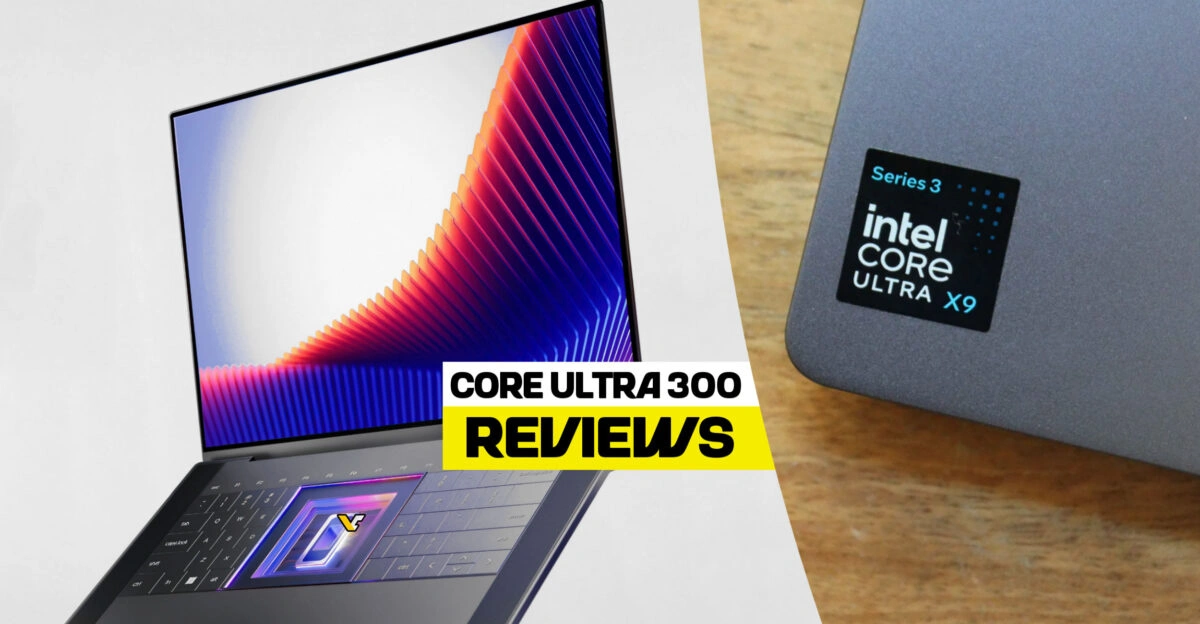
The first large-scale benchmarks of Intel Core Ultra X processors are live - and they finally show what Intel’s new top-tier mobile chips are capable of, especially when it comes to integrated graphics.
After weeks of speculation, the wait is over.
Major tech outlets have now published full reviews of Intel’s new Core Ultra X processors — though only for the top-tier models equipped with Intel’s most powerful integrated GPU. And for the first time, we can clearly see where Intel’s latest mobile CPUs stand.
The short version?
The CPU side looks familiar.
The iGPU story is where things get interesting.
CPU performance: solid, efficient and predictable
Starting with raw CPU performance, Intel largely delivered what it had already promised.
In multi-core workloads, top Core Ultra 300 X models perform roughly on par with Intel’s previous Arrow Lake–based chips. A flagship Panther Lake configuration with 16 cores (4P + 8E + 4 LP-E) lands in the same general performance class as earlier 16-core Core Ultra 200 processors, such as the Core Ultra 9 285H (6P + 8E + 2 LP-E).
That puts Intel in familiar territory.
Depending on the application, performance also overlaps with:
- AMD Ryzen AI HX 370
- Apple M4 / early M5-class systems
As usual, results vary significantly by workload — some apps favor Intel, others AMD or Apple. But taken as a whole, Core Ultra 300 X doesn’t radically outperform its predecessors on the CPU side.
That said, this is still a strong result for power-efficient mobile CPUs, not a disappointment.
Integrated graphics: This is the real leap
The real headline is Intel’s new Arc B390 iGPU.
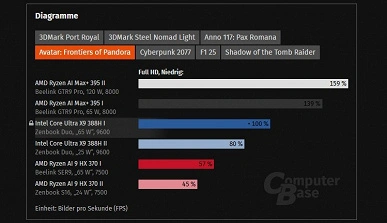
In gaming and graphics benchmarks, Arc B390 sets a new bar for integrated graphics, outperforming AMD’s Ryzen 890M by 50–70% in many tests. That’s not a marginal gain — it’s a generational jump.
Yes, AMD’s Radeon 8050S and 8060S iGPUs remain faster overall, even at similar power levels. But those chips belong to a different category. Where Intel’s Core Ultra X power limits end, AMD’s Ryzen AI Max platform is only getting started.
Source: ComputerBase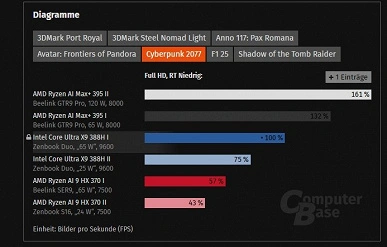
Source: ComputerBaseIn context, Intel’s achievement here is significant.
iGPU vs Discrete graphics: A surprising comparison
When reviewers compared Intel’s new iGPU to entry-level discrete GPUs, the results raised eyebrows.
Performance lands roughly in the range of an RTX 4050 Laptop GPU.
Until now, that level of graphics power was simply unreachable for integrated solutions in this class. For thin-and-light laptops without a discrete GPU, this changes expectations entirely — especially for casual gaming and GPU-accelerated workloads.
Battery life: very good, not revolutionary
Battery life results are more nuanced.
Laptop autonomy is notoriously hard to compare due to:
- Different battery capacities
- Different screen configurations
- Highly variable workloads
Still, two conclusions stand out:
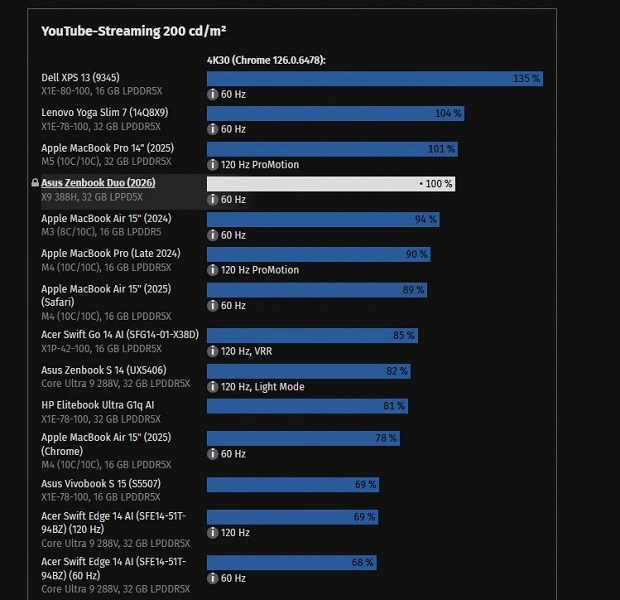
- Core Ultra X chips are genuinely energy-efficient
In some scenarios, they compete directly with MacBooks and Snapdragon-based laptops. - There’s no dramatic battery-life breakthrough
Sometimes Intel delivers best-in-class x86 results — but not consistently.
In short: battery life is very good, but the leap here isn’t nearly as dramatic as what Intel achieved with the iGPU.
Source: ComputerBasePricing will decide everything
The biggest unanswered question is pricing.
If laptops built around Core Ultra X models with the Arc B390 iGPU come in cheaper than systems with Ryzen AI Max or RTX 4050-class discrete GPUs, Intel could be sitting on a very compelling product.
And there’s one more advantage Intel holds in almost every scenario:
- Better battery life compared to laptops with discrete GPUs
If OEM pricing aligns with performance, Core Ultra X laptops could hit a very attractive sweet spot.
Final take
Intel Core Ultra X processors don’t redefine mobile CPU performance — and they don’t need to.
Instead, they deliver:
- Competitive CPU efficiency
- A massive leap in integrated graphics
- Strong battery life for x86 laptops
If pricing is right, these chips could quietly reshape what buyers expect from thin-and-light laptops without discrete GPUs.
Sources: ComputerBase
Subscribe!
Subscribe to our newsletter and be in touch with high-tech news
Top Read
A LEGO game wants RTX 3080: Why LEGO Batman’s system requirements shock everyone

MSI launches XpertStation WS300 with Nvidia GB300 Blackwell: up to 496GB RAM and supercomputer hardware in desktop format
Cooler Master’s G360 Dragon Shadow SE Puts an Infinity Mirror on Your CPU Block for $66
EPOMAKER RT100 PRO Ships With a Screen You Can Rip Out for Extra Keys

Intel Core Ultra 7 270K Plus and Core Ultra 5 250K Plus: 24 Cores, 5.5 GHz, $299
