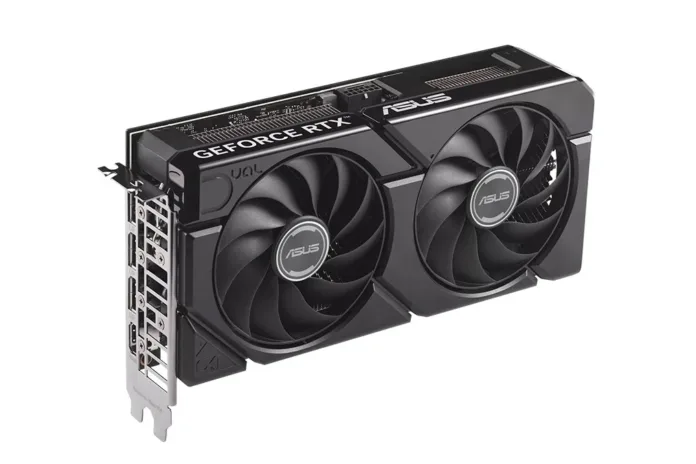
ASUS shrinks the RTX 5070 to 2.5 slots with the new Dual EVO series. At 229mm long and 50mm thick, it targets ITX and SFF builders who've been waiting for compact Blackwell options.
At a glance: ASUS Dual RTX 5070 EVO measures 229 × 120 × 50mm (2.5 slots), making it one of the shortest RTX 5070 cards available. Runs on a single 16-pin connector at ~220W. Fits ITX cases with 230mm+ GPU clearance. Two variants: base model at 2512 MHz boost, OC at 2542 MHz. No pricing announced yet.
ASUS just dropped the Dual RTX 5070 EVO series. The numbers: 229 x 120 x 50mm. Compare that to the standard Dual at 249 x 126 x 50.6mm. Twenty millimeters shorter. Doesn’t sound like much until you’ve spent an evening trying to close a side panel that won’t quite close.
The thickness? 2.5 slots. Down from 2.53 technically. Nobody will notice that 0.03-slot difference. I certainly won’t. What matters is staying under that psychological barrier where SFF cases draw the line.
Cooling – the part that worries me
Here’s the thing about compact GPUs. Less space means less heatsink. Less heatsink means more heat. Physics doesn’t care about marketing.
ASUS equipped this card with axial-tech fans – supposedly more durable than standard blades. They also included 0dB mode for light loads. I’ve used this on previous ASUS cards. Works fine. Complete silence at the desktop, fans kick in when you actually need them.
The backplate has ventilation cutouts. Sounds minor. It’s not.
Compact dual-fan coolers typically run 5-8°C warmer than triple-fan designs in open-air testing, though this gap narrows in restricted SFF enclosures where larger coolers can’t pull enough fresh air anyway. The real question is noise — ASUS’s 0dB mode helps at idle, but load behavior in a 10-liter case remains untested.
In sandwich-style ITX cases your GPU sits millimeters from the side panel. Solid backplate? Heat pools. Vented backplate? Air moves. Real difference in tight spaces.
Power comes through a single 16-pin 12V-2×6 connector. ASUS says 850W PSU. Also 750W. Depends which spec sheet you read. The inconsistency tells me either works fine. These cards pull around 220W under load – not exactly power hungry by modern standards.
Two models, barely different
ASUS is launching two variants:
Dual RTX 5070 EVO
- Base boost: 2512 MHz
- OC mode: 2542 MHz
Dual RTX 5070 EVO OC
- Base boost: 2542 MHz
- OC mode: 2572 MHz
That’s a 30 MHz difference.
Specs comparison
| Specification | Dual RTX 5070 EVO | Dual RTX 5070 EVO OC | RTX 5070 FE |
|---|---|---|---|
| Length | 229mm | 229mm | 267mm |
| Width | 120mm | 120mm | 137mm |
| Thickness | 2.5 slots (50mm) | 2.5 slots (50mm) | 2.5 slots |
| Boost Clock | 2512 MHz | 2542 MHz | 2512 MHz |
| Power Connector | 1× 16-pin | 1× 16-pin | 1× 16-pin |
| TDP | ~220W | ~220W | 220W |
| Fans | 2 (axial-tech) | 2 (axial-tech) | 2 |
| 0dB Idle Mode | Yes | Yes | No |
| Min Case Clearance | 230mm | 230mm | 270mm |
The 20mm length reduction over standard Dual models — and 38mm shorter than Founders Edition — opens compatibility with cases like the Dan A4, FormD T1, and Meshlicious that couldn’t fit reference designs.
You will never see this in any game. Ever. The OC model exists for people who want factory overclocks without touching software. Fine. But don’t pay more than $20 extra for it. Not worth it.
Why SFF builders should care
The RTX 5070 launch was rough for compact PC people. Reference cards? Huge. Most AIB cards? Also huge. Triple-slot monsters that laugh at your FormD T1.
The compact GPU shortage has been a recurring complaint in SFF communities. As one r/sffpc moderator put it last month: “Every generation, we wait months for AIB partners to remember that not everyone builds in a mid-tower.” ASUS appears to have heard that feedback — the Dual EVO announcement came faster than similar compact variants did for the RTX 40 series.
This changes things. Not dramatically. But enough.
At 229mm this card clears the 230mm limit in cases like the Meshlicious, NR200, and FormD T1. The 2.5-slot thickness works in most sandwich layouts. Still a substantial card – we’re not talking slim by any stretch – but doors that were closed are now open.
My concern? Thermals. ASUS hasn’t published numbers yet. A 220W GPU in a compact cooler inside a restricted-airflow case… I want to see real data before recommending this for builds where the GPU bakes in its own heat.
Less mass. More heat. Simple.
Price and availability – the usual mystery
No pricing announced. No release date. Classic GPU launch behavior at this point.
Based on previous Dual EVO cards: probably $20-40 over MSRP. The OC version adds another $20-30. These are guesses. Could be wrong.
Regional availability is the real question mark. SFF building is huge in Asia and parts of Europe where apartments are small and desk space is precious. Will ASUS ship there first? Or stick with the usual US-priority distribution?
No idea. They’re not saying.
ASUS Dual RTX 5070 EVO: quick answers
229 x 120 x 50mm. 2.5 slots. Check your case specs. Most SFF cases with 230mm+ clearance will work. Sandwich layouts need 2.5-slot support minimum. Measure twice.
Valid. Dual axial fans, 0dB idle mode, vented backplate. Sounds good on paper. Real thermal performance in actual SFF cases? Unknown. I’d wait for reviews if you’re building in something truly cramped.
ASUS hasn’t announced official release dates or pricing. Based on previous AIB launch patterns, expect retail availability 2-4 weeks after announcement. Pricing typically lands $20-50 above Nvidia’s MSRP for dual-fan compact models. Stock shortages at launch are likely given current GPU demand.
The RTX 5070 delivers roughly 20-25% better rasterization performance than the RTX 4070, with larger gains in ray tracing workloads. Power draw increases modestly from ~200W to ~220W. Compact RTX 4070 options like the ASUS Dual measured 227mm — nearly identical to the new 5070 EVO’s 229mm. Upgraders shouldn’t need case changes.
30 MHz difference. Meaningless in practice. Buy whichever costs less or ships sooner. Don’t overthink this one.
750-850W recommended. Card draws about 220W. Quality 650W units would probably work but SFF PSUs run tighter on headroom. Stick with 750W to be safe.
Sources: ASUS Official, ITHOME, Nvidia RTX 5070 specifications
Subscribe!
Subscribe to our newsletter and be in touch with high-tech news
Top Read
A LEGO game wants RTX 3080: Why LEGO Batman’s system requirements shock everyone

MSI launches XpertStation WS300 with Nvidia GB300 Blackwell: up to 496GB RAM and supercomputer hardware in desktop format
Cooler Master’s G360 Dragon Shadow SE Puts an Infinity Mirror on Your CPU Block for $66
EPOMAKER RT100 PRO Ships With a Screen You Can Rip Out for Extra Keys

Intel Core Ultra 7 270K Plus and Core Ultra 5 250K Plus: 24 Cores, 5.5 GHz, $299
