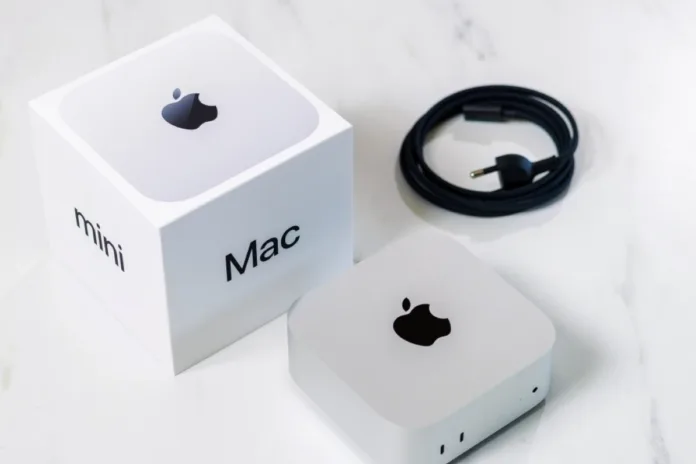
Apple announced today that Mac mini production moves to Houston later this year, marking the first time the compact desktop has been assembled on US soil—and potentially the first domestically-built Mac since the short-lived 2013 Mac Pro experiment.
Apple confirmed today what supply chain watchers have been guessing for months. The Mac mini will be assembled in Houston starting later this year. The move marks the first time Apple’s compact desktop has been built in the US. It’s possibly the first US-assembled Mac since the 2013 Mac Pro fizzled out in Texas before production shifted back to China.
The Houston expansion goes beyond just the Mac mini. Apple says it’s ramping up production of what it vaguely calls “advanced AI servers” at the same facility. These are likely the custom chips powering Apple Intelligence cloud features. Tim Cook framed the announcement as part of Apple’s broader $600 billion commitment to US manufacturing. The real story is messier than the press release suggests.
TSMC Arizona becomes Apple’s domestic chip lifeline
Here’s the number that matters: Apple plans to source over 100 million chips from TSMC’s Arizona fabs in 2026. That’s a huge jump from 2025 volumes. It’s not a token gesture. It’s enough silicon to cover most of Apple’s M-series desktop chip needs. That assumes the rumors about M4 Mac mini sales projections hold up. TSMC’s Phoenix operation has struggled with yield issues and labor disputes since breaking ground. Hitting triple-digit million chip volumes would be a real milestone.
The cost premium nobody mentions
The catch? Those TSMC Arizona chips will cost Apple much more per unit than Taiwan-made silicon. Industry sources peg the premium anywhere from 20–35% depending on chip complexity. Apple’s absorbing that cost for now. Don’t expect the savings to trickle down to retail pricing. The M4 Mac mini already costs $599, and that’s before factoring in domestic assembly labor.
What actually changes
Only the final assembly step changes. Apple’s Houston partner will handle board population, thermal assembly, and chassis integration. The company didn’t name names, but Foxconn and Pegatron both operate Texas facilities. Critical subcomponents still come from Asian suppliers. Display controllers, power management ICs, NAND flash – all still Asian-sourced. This isn’t full vertical integration. It’s strategic packaging of politically visible products to satisfy Buy American optics.
The ripple effect: wafers, packaging, and glass
Apple’s dragging its suppliers along for the ride. GlobalWafers fired up its $4 billion Sherman, Texas facility late last year. The plant produces the raw silicon wafers that TSMC Arizona turns into chips. Amkor broke ground on a $7 billion advanced packaging plant in Peoria, Arizona. Apple’s allegedly the anchor customer. That makes sense given how much chiplet-based packaging the M-series family requires.
The Kentucky glass detour
The weirdest flex? Corning’s Harrodsburg, Kentucky factory now only makes cover glass for iPhones and Apple Watches. By year-end, every new iPhone and Watch ships with Kentucky glass. This replaces what used to come from Corning’s Taichung plant. It’s a symbolic win but a logistical headache. Kentucky glass still needs to ship to Asia for lamination and coating before coming back to final assembly sites. The carbon footprint probably worsened.
I’ve been tracking Apple’s supply chain moves since the 2019 tariff fights. This feels less like genuine reshoring and more like strategic hedging. Apple’s building backup into its supply chain to protect itself from future US-China trade limits. The company’s not abandoning Asian manufacturing. It’s just adding expensive domestic capacity as insurance.
The jobs pitch and the fine print
Apple promises “thousands of jobs” in Houston. The company’s been vague about whether that’s direct Apple employment or contractor headcount across multiple sites. The 2013 Mac Pro experiment created around 500 jobs in Austin. That wound down quietly when Apple moved production to China in 2019. This feels like a bigger commitment. But modern electronics assembly uses heavy automation. “Thousands of jobs” might mean far fewer human workers than it would have a decade ago.
The Detroit training push
The Apple Manufacturing Academy in Detroit is genuinely interesting. Apple offers hands-on training in AI-driven automation, smart manufacturing, and robotics. Over 130 small and mid-sized US manufacturers get this training. Michigan State co-developed the curriculum. The virtual courses now reach companies nationwide. This actually builds domestic manufacturing capacity instead of just moving existing jobs around. Though cynics will note it also trains Apple’s future supplier base to meet the company’s strict quality standards.
What this means for Mac buyers
Short answer: nothing immediately visible. Your Mac mini won’t get cheaper. Apple’s not stamping “Assembled in USA” on the box as a premium feature (yet). The Houston-built units will work just like anything rolling off Foxconn’s Shenzhen lines. Same M4 chip, same thermal design, same I/O layout.
The long-term play
Longer term? If Apple successfully scales domestic production and hits the same yield as Asian facilities, it creates options. A future administration could slap 60% tariffs on Chinese electronics tomorrow. Apple would have a partial escape route. Competitors still sourcing everything from Shenzhen would face brutal margin hits. That strategic cushion is worth billions in avoided risk. The per-unit economics look terrible on a spreadsheet today, but that’s not the point.
Following the CHIPS Act money
Another angle: if the CHIPS Act subsidies survive future budget fights, Apple locks in federal money. This offsets some of that TSMC Arizona cost premium. The company hasn’t disclosed subsidy details. TSMC’s Phoenix fabs are getting around $6.6 billion in CHIPS Act grants. Apple effectively benefits as TSMC’s largest customer.
The stuff nobody’s talking about
The environmental silence
What’s clearly missing from Apple’s announcement: any mention of environmental impact. Domestic chip manufacturing uses vastly more carbon per chip than Taiwan’s hydro-heavy grid. Arizona’s water supply is already strained. TSMC’s fabs consume millions of gallons daily. Apple talks endlessly about carbon neutrality. Reshoring chip production actively works against those goals unless the company’s paying for massive renewable energy buildouts. They haven’t announced any.
Which chips actually come from Arizona?
Also absent: details about which M4 variants come from Arizona. The base M4 for Mac mini? Sure, that’s believable at 100 million unit volumes. But the M4 Pro, M4 Max, and M4 Ultra are far more complex dies with lower yields. Sourcing those domestically at competitive cost seems unlikely. Apple’s probably limiting Arizona output to the highest-volume, lowest-margin chips. That’s where subsidies can actually move the needle.
The vague timeline problem
One last thing: Apple says Houston production starts “later this year.” That’s a super vague timeline for a supply chain this complex. Ramping from zero to meaningful Mac mini volumes in six months would be unusual. More realistic is a small pilot run in Q4 2026 to hit the political messaging window. Real volume production likely slides into 2027. Apple’s built enough slack into this announcement that delays won’t look like failures.
Questions and answers:
Apple says Houston production starts later in 2026. The exact timing remains vague. Initial volumes will likely be limited pilot runs. Meaningful production scales into 2027. Not every Mac mini will be US-assembled. Apple’s maintaining parallel Asian production lines.
TSMC makes the M4 chips inside Mac mini. They come from TSMC fabs in Taiwan. Starting in 2026, some come from TSMC’s Arizona facilities. Apple plans to source over 100 million chips from TSMC Arizona in 2026. Houston assembles Mac minis for US-destined units. China handles assembly for global markets.
Strategic hedging against future tariffs and trade limits, not cost savings. Domestic assembly costs much more than Asian production. But it gives Apple supply chain backup and qualifies for CHIPS Act subsidies. It’s also politically valuable optics as US-China tech tensions grow.
No. Domestic production costs more due to higher labor rates and the TSMC Arizona chip premium. That’s 20–35% above Taiwan pricing. Apple’s absorbing those costs for now. There’s zero indication of price cuts. If anything, future models might see price increases if subsidy programs expire.
Apple claims “thousands of jobs” but hasn’t specified the details. Is that direct employment or contractor headcount across multiple partners? The 2013 Mac Pro created around 500 Austin jobs before production moved to China in 2019. Expect heavy automation to limit headcount compared to traditional manufacturing.
Currently, just cover glass for iPhones and Apple Watches. Corning makes those in Kentucky. Now add Mac mini assembly in Houston. Apple also builds custom AI servers domestically for Apple Intelligence cloud infrastructure. Everything else still comes from Asian manufacturing hubs. That includes iPhones, iPads, MacBooks, and accessories.
Sources: Apple press release, TSMC investor disclosures, GlobalWafers Sherman facility announcements, Amkor Arizona construction filings
Subscribe!
Subscribe to our newsletter and be in touch with high-tech news
Top Read
A LEGO game wants RTX 3080: Why LEGO Batman’s system requirements shock everyone

MSI launches XpertStation WS300 with Nvidia GB300 Blackwell: up to 496GB RAM and supercomputer hardware in desktop format
Cooler Master’s G360 Dragon Shadow SE Puts an Infinity Mirror on Your CPU Block for $66
EPOMAKER RT100 PRO Ships With a Screen You Can Rip Out for Extra Keys

Intel Core Ultra 7 270K Plus and Core Ultra 5 250K Plus: 24 Cores, 5.5 GHz, $299
