
AMD has quietly revealed a new piece of hardware that stands out from the typical desktop or mini-PC crowd: the Ryzen AI Halo, a super-compact computer built under AMD’s own brand and designed specifically for artificial intelligence development. This isn’t a consumer-friendly machine you’d pick up instead of a gaming rig or living room PC – it’s a specialized system meant to handle local AI workloads without a pre-installed operating system.
What the Ryzen AI Halo actually is
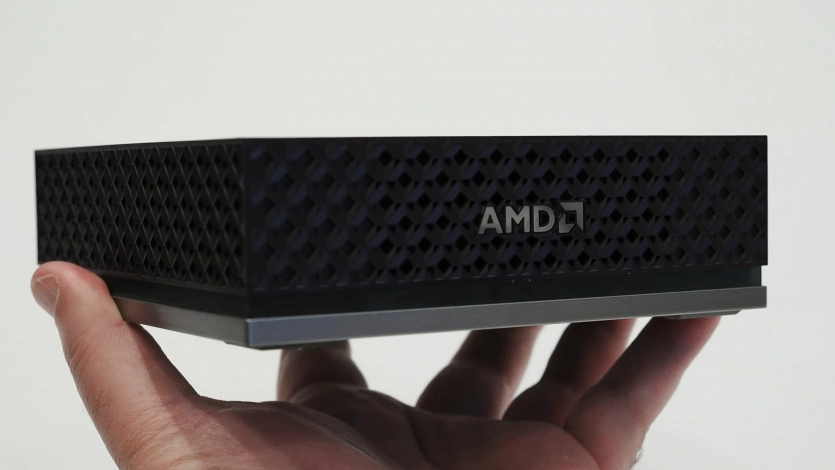
At first glance, the Ryzen AI Halo looks like a high-end tiny PC – one you might overlook beside even standard mini-PCs, but it’s strikingly smaller than most devices you’ve likely seen. AMD focused not just on squeezing compute into a small footprint, but on doing so without obvious compromises.
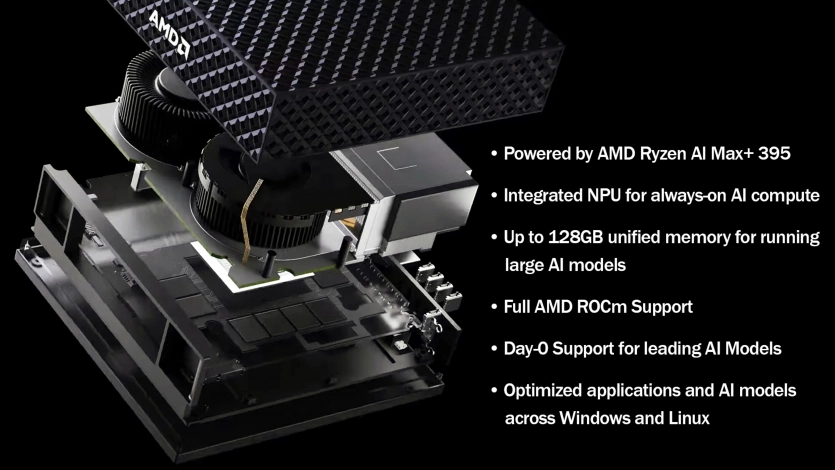
Inside, the Halo packs a processor from the Ryzen AI Max 300 series, also known by the codename Strix Halo. These chips combine CPU, GPU, and an NPU (neural processing unit) into a single silicon package, giving the system a strong foundation for AI inference and machine learning tasks at the edge.
In addition, AMD’s design supports up to 128 GB of LPDDR5 memory in a high-bandwidth configuration with unified memory architecture – a feature that allows the GPU and other units to share access to a large pool of fast RAM. That setup isn’t typical for ultra-small computers but is crucial for handling large AI models locally without frequent data shuffling.
Ports, design, and usability
Despite its palm-sized form factor, the Ryzen AI Halo doesn’t cut corners on connectivity. The chassis includes:
- Four USB-C ports for high-speed data, displays, and peripherals
- A full-size HDMI output
- A standard Ethernet jack for reliable wired networking
For such a compact hardware build, this generous port selection is unusual – many micro-form factor systems rely on dongles or expansion hubs to achieve similar connectivity.
Since AMD offers this platform without a preloaded operating system like Windows or Linux, developers are expected to install and configure their own software environments. That approach reinforces the focus on flexibility and experimentation rather than out-of-the-box consumer use.
Who the PC is for (and who it isn’t)
The Ryzen AI Halo is squarely targeted at developers, researchers, and AI engineers who need hardware capable of local compute for inference, testing, or prototyping without immediately resorting to cloud platforms. Its ultra-compact design makes it appealing for labs, edge AI deployments, or even desktop setups where space is at a premium.
However, this isn’t a replacement for your everyday workstation or gaming PC:
- There’s no consumer operating system included.
- General productivity tools aren’t pre-configured.
- Performance will vary significantly depending on workloads and memory configuration.
If your primary goal is general computing, gaming, or casual content creation, a traditional desktop or laptop will remain a better pick.
Availability and expectations
AMD plans to begin shipments of the Ryzen AI Halo in the second quarter of 2026, though an official price hasn’t been announced yet. Based on similar systems built around Strix Halo processors, the retail cost could fall in the range of $1,500 – $2,500, depending on memory and configuration choices.
Even though this is a niche launch, it’s a notable shift for AMD: a brand-named PC built from the ground up for edge AI rather than traditional end-user segments. It highlights a broader industry trend toward specialized hardware that meets the needs of developers working with large models and advanced workloads locally.
Source: techradar
Subscribe!
Subscribe to our newsletter and be in touch with high-tech news
Top Read
A LEGO game wants RTX 3080: Why LEGO Batman’s system requirements shock everyone

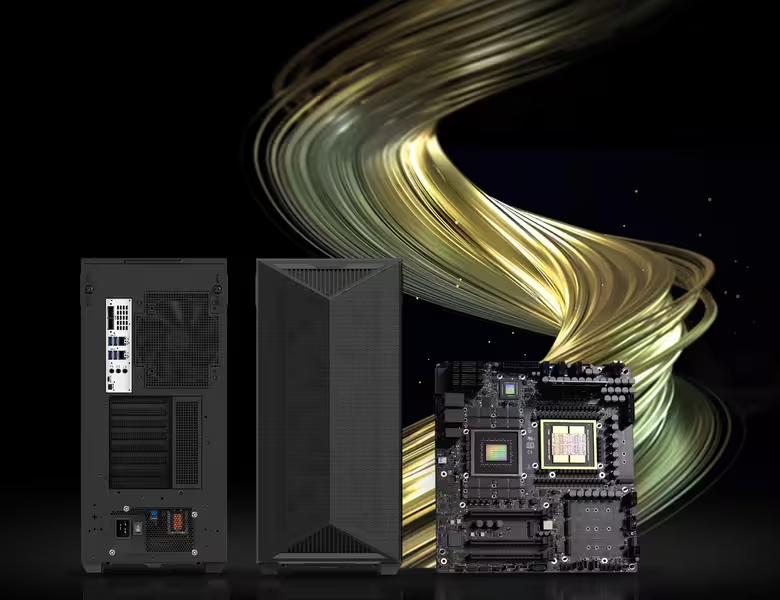
MSI launches XpertStation WS300 with Nvidia GB300 Blackwell: up to 496GB RAM and supercomputer hardware in desktop format
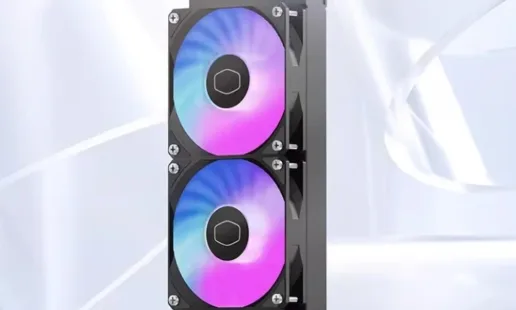
Cooler Master’s G360 Dragon Shadow SE Puts an Infinity Mirror on Your CPU Block for $66
EPOMAKER RT100 PRO Ships With a Screen You Can Rip Out for Extra Keys

Intel Core Ultra 7 270K Plus and Core Ultra 5 250K Plus: 24 Cores, 5.5 GHz, $299
