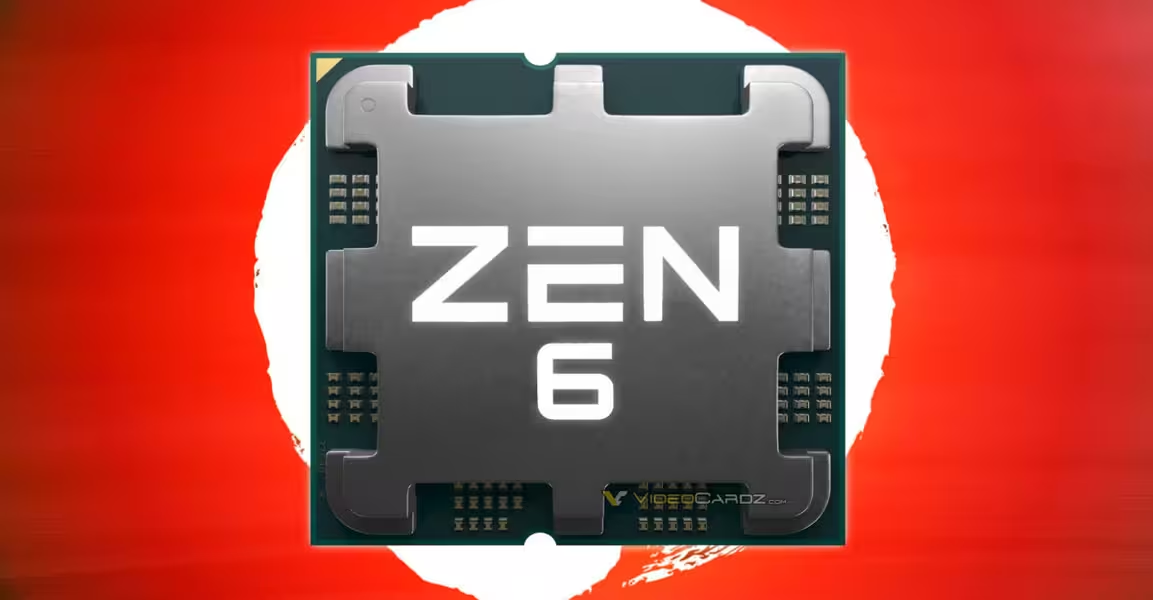
AMD's upcoming Zen 6 Ryzen lineup reportedly spans 6 to 24 cores — including entry-level chips Intel abandoned on its side. With 48MB of L3 cache per chiplet baked in by default, even the budget tier looks interesting.
AMD’s next-generation Ryzen processors on the Zen 6 architecture are expected sometime in late 2026 or early 2027, and a new leak from insider HXL — posting as @9550pro on X — fills in a piece of the picture that earlier reports left blank: the full core count spread. According to HXL’s data, the Zen 6 lineup will cover configurations from 6 to 24 cores, including single-chiplet models at 6, 8, 10, and 12 cores, plus dual-chiplet variants at 16 (8+8), 20 (10+10), and 24 (12+12) cores. The 24-core ceiling had already surfaced in previous leaks; the 6-core floor had not, and its inclusion carries strategic significance given how Intel handled its own recent lineup decisions.
HXL has a credible track record on AMD and Intel hardware ahead of official announcements. HXL broke the RTX 4090 overclocking data, the Core i5-13400 specs, and Ryzen AI 300 iGPU details before their official reveals. That track record makes the Zen 6 core count data worth taking seriously. Pre-release specs can still shift before launch — but this source has earned the benefit of the doubt.
AMD is making a different bet than intel on Entry-Level
The most strategically interesting detail in the Zen 6 leak isn’t the 24-core ceiling — that was expected for AMD’s enthusiast positioning — it’s the 6-core floor. Intel’s approach with its current product stack has leaned toward retiring sub-8-core configurations from its leading-edge architecture, pushing budget buyers toward older generations or efficiency-focused mobile silicon rather than building fresh 6-core desktop parts on the latest process node. That decision simplifies Intel’s lineup and improves margins at the cost of leaving entry-level desktop buyers with less compelling upgrade paths.
AMD’s apparent choice to maintain 6-core Zen 6 variants runs contrary to that strategy, and it’s defensible from several angles. The AM4 platform’s success — covered in recent sales data showing B550 boards still topping Amazon bestseller charts in early 2026 — proved that AMD’s budget tier drives substantial volume even when premium tiers generate better margins. A 6-core Zen 6 CPU on AM5 would replace the aging Ryzen 5 5600X with something architecturally current — 48MB of L3 included. First-time AM5 buyers would get a real entry point, not a forced choice between last-gen silicon and an over-specced 8-core chip.
48MB L3 per chiplet changes the value equation across the entire stack
Earlier reporting had already surfaced the 48MB L3 cache figure per CCD (Core Complex Die) chiplet — a significant increase over the 32MB per CCD in current Zen 4 processors. That number deserves its own attention, because it reconfigures how AMD’s cache advantage works across the full lineup rather than concentrating it in X3D-suffixed premium models.
What 96MB without X3D actually means
With 48MB per chiplet in the base architecture, a single-chiplet 12-core Zen 6 chip ships with 48MB of L3 by default. The dual-chiplet 24-core model hits 96MB — no 3D V-Cache stacking required, unlike the Ryzen 7 7800X3D and 9800X3D today.
Titles that gained the most from X3D V-Cache — Microsoft Flight Simulator, Baldur’s Gate 3, strategy games with heavy AI workloads — could see meaningful gains on standard Zen 6 hardware. No X3D surcharge required. Whether AMD still releases X3D versions of Zen 6 on top of this elevated baseline is unconfirmed, but a 96MB or 128MB+ X3D configuration is plausible and would represent a substantial leap over today’s 3D V-Cache implementations.
What the symmetric Dual-Chiplet design tells us
The specific dual-chiplet configurations in the leak — 8+8, 10+10, 12+12 — indicate AMD is pursuing symmetric chiplet pairing rather than asymmetric designs like Intel’s Performance + Efficiency hybrid architecture. That’s consistent with AMD’s existing chiplet approach on Zen 4, where high-core-count Ryzen 9 models combine two identical CCDs rather than mixing different core types on one package. Symmetric designs simplify scheduling for the operating system — both Windows 11 and Linux can treat all cores as equivalently capable, avoiding the thread prioritization complexity that Intel’s hybrid architecture requires. For gaming workloads particularly, where frame consistency depends on predictable core behavior, symmetric chiplet designs have historically delivered cleaner performance than heterogeneous alternatives.
The 10-core single-chiplet and 20-core dual-chiplet configurations are less conventional — AMD’s current lineup skips 10-core desktop chips entirely — and suggest that Zen 6’s CCD might shift from 8 cores per chiplet to a maximum of 12, enabling the 10-core binned variant and the 20-core dual-chiplet configuration that don’t exist in the current architecture’s geometry.
Release timeline remains genuinely uncertain
HXL’s leak provides topology data but no confirmed release window, and the “late 2026 or early 2027” framing reflects real uncertainty rather than conservative hedging. AMD’s Zen 5 desktop chips launched in August 2024. A typical annual cadence points to Zen 6 desktop parts in mid-to-late 2026 — though AMD has slipped timelines before. Mobile silicon could also ship first, as it did with Zen 4 and the initial Ryzen 7000 rollout. Intel’s Nova Lake — the competing architecture expected in roughly the same timeframe — adds competitive pressure that could either accelerate AMD’s launch schedule or force the company to hold until Zen 6 is ready to compete on full specifications.
Until AMD announces Zen 6 officially, treating every detail in this leak as preliminary is the appropriate posture. Core counts, cache configurations, and chiplet designs can all change between architectural planning and tape-out, and pre-release leaks have been wrong about similar details before — including some of AMD’s own internal roadmap documents that showed specifications that didn’t survive to production.
FAQ
According to insider HXL (@9550pro), the Zen 6 Ryzen lineup will span from 6 to 24 cores. Single-chiplet models are expected at 6, 8, 10, and 12 cores, while dual-chiplet configurations will reach 16 (8+8), 20 (10+10), and 24 (12+12) cores. These figures come from a pre-release leak and haven’t been confirmed by AMD, so specific configurations may change before the official announcement.
Each Zen 6 CCD (Core Complex Die) chiplet reportedly carries 48MB of L3 cache, up from 32MB per CCD in current Zen 4 architecture. A single-chiplet Zen 6 chip would have 48MB of L3 by default; the dual-chiplet 24-core model would reach 96MB without any X3D V-Cache stacking. That’s a significant baseline increase that benefits all Zen 6 processors, not just the premium X3D-suffixed variants that currently dominate cache-sensitive gaming benchmarks.
Based on the HXL leak, yes — AMD plans to include 6-core configurations in the Zen 6 desktop lineup, which would be a meaningful departure from recent Intel strategy that retired low-core-count parts from its latest architectures. A 6-core Zen 6 chip on AM5 would provide current-generation architecture to budget builders who currently face a choice between last-gen AM4 hardware and over-specced AM5 entry points, potentially revitalizing budget segment AM5 adoption that has lagged due to platform cost concerns.
No official release date has been announced. The expected window based on AMD’s typical annual architecture cadence is late 2026 or early 2027, though AMD has shifted timelines before and mobile variants may precede desktop availability. Intel’s Nova Lake architecture is anticipated in a similar timeframe, creating competitive pressure that could influence AMD’s launch scheduling in either direction. AMD has not commented on Zen 6 release timing publicly.
HXL (@9550pro) has a demonstrated track record of accurate pre-release hardware data, including early RTX 4090 overclocking specifications, Core i5-13400 details before Intel’s announcement, and Ryzen AI 300 integrated graphics information. That history makes this leak more credible than anonymous speculation, though pre-release specifications — particularly topology and core count details — can change between architectural planning and final production. Treating these figures as directionally accurate rather than confirmed is the appropriate approach until AMD makes an official announcement.
Sources: HXL / @9550pro on X, Videocardz
Subscribe!
Subscribe to our newsletter and be in touch with high-tech news
Top Read
A LEGO game wants RTX 3080: Why LEGO Batman’s system requirements shock everyone

MSI launches XpertStation WS300 with Nvidia GB300 Blackwell: up to 496GB RAM and supercomputer hardware in desktop format
Cooler Master’s G360 Dragon Shadow SE Puts an Infinity Mirror on Your CPU Block for $66
EPOMAKER RT100 PRO Ships With a Screen You Can Rip Out for Extra Keys

Intel Core Ultra 7 270K Plus and Core Ultra 5 250K Plus: 24 Cores, 5.5 GHz, $299
