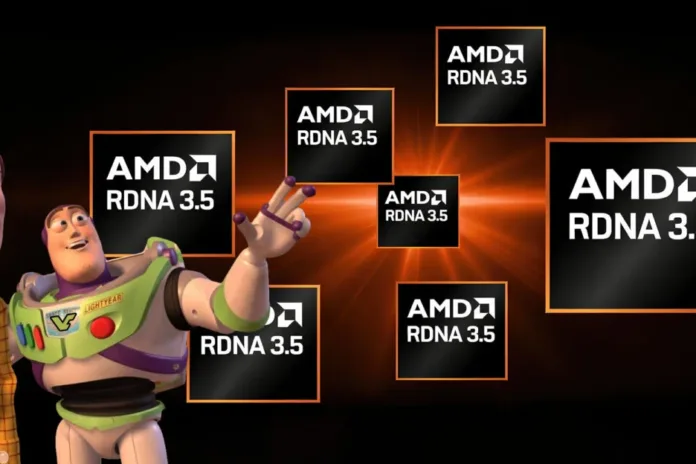
AMD’s RDNA 3.5 architecture brings meaningful performance and efficiency gains to integrated graphics, narrowing the gap with entry-level discrete GPUs and making modern laptops and handheld PCs far more capable without sacrificing battery life.
AMD’s latest graphics update isn’t a full-blown new GPU architecture – but it feels like one for integrated graphics. The company’s RDNA 3.5 architecture represents a focused refinement of its previous RDNA 3 design, aimed squarely at boosting performance and efficiency in low-power contexts like laptops, handhelds, and mobile APUs.
Here’s what that evolution means for real-world performance, why RDNA 3.5 matters, and how AMD’s newest integrated GPUs stack up in 2026.
What AMD RDNA 3.5 actually is
Think of RDNA 3.5 as RDNA 3, but tuned and optimized, not replaced. Unlike a ground-up redesign, RDNA 3.5 refines key parts of the graphics pipeline to improve performance per watt and overall throughput. Key changes include doubling texture sampler and pixel interpolation rates, optimizing memory access patterns, and generally squeezing more work out of each compute unit (CU).
Those tweaks are especially useful when graphics hardware is constrained by tight power limits – the exact situation for integrated GPUs in thin laptops and handheld devices.
The first iGPUs to use RDNA 3.5
RDNA 3.5 shows up in AMD’s Ryzen AI 300 “Strix Point” processors on the GPU side, specifically:
- Radeon 890M: 16 compute units
- Radeon 880M: 12 compute units
These are the first widely tested RDNA 3.5 iGPUs, and they demonstrate what AMD’s shader tweaks and pipeline improvements can do.
Performance gains you can actually feel
Compared to last-generation RDNA 3 integrated GPUs, the new RDNA 3.5 units deliver solid uplifts:
- 19%–32% higher scores in synthetic GPU benchmarks like 3DMark at the same power level.
- Up to ~46% faster graphics compute scores in Vulkan and OpenCL tests versus RDNA 3.
That’s a meaningful jump – not just in benchmarks, but in everyday usage. For gamers and content creators using laptops with RDNA 3.5 iGPUs, this can translate into smoother gameplay at 1080p in esports or lighter titles, and snappier UI and media performance.
Showdown: RDNA 3.5 iGPU vs. Entry-level discrete GPUs
One of the most interesting outcomes from early testing is how close RDNA 3.5 integrated graphics can get to low-end discrete GPUs:
- The Radeon 890M RDNA 3.5 often beats or matches performance of NVidia-class entry-level cards like the RTX 3050 4 GB or Radeon RX 6400 in certain tests – all while drawing far less power.
For devices like ultraportable laptops or handheld gaming PCs where power and heat are limited, that’s a huge deal. You’re looking at performance that feels like a discrete GPU in many scenarios, without the extra space, cooling, or battery drain.
Why AMD didn’t just jump to RDNA 4
Even though AMD continues advancing discrete GPU architectures with RDNA 4 for standalone graphics cards, the company deliberately stuck with RDNA 3.5 for integrated graphics in its mobile and APU lineup. The reason? RDNA 3.5 hits a sweet spot in performance per watt and fits the power envelopes of laptops and handhelds far better than a full-on RDNA 4 design would.
This decision boosts real-world efficiency – and aligns with what most users want from thin and light devices: responsive graphics without throttling or early battery exhaustion.
Real-world takeaways
Here’s what RDNA 3.5 means for you:
- Better mobile GPU performance: Not just iterative gains – measurable uplifts in both benchmarks and gameplay.
- Discrete-like power in an integrated chip: RDNA 3.5 iGPUs are finally encroaching on entry-level dGPU territory.
- Efficient for thin and light devices: Improvements aren’t just about speed – they also lean into power and memory efficiency.
Who needs to pay attention
If you’re shopping for a gaming or productivity laptop without a dedicated GPU, RDNA 3.5 makes that choice more compelling. Titles that once felt stuttery at low settings may now be smoother thanks to these architectural tweaks. Content creators working on lighter video or 3D tasks will also notice better performance over older RDNA designs.
If you’d like a comparison table of RDNA 3.5 vs RDNA 3 iGPUs or a breakdown of which laptops and APUs are shipping with these new graphics right now, just let me know.
Sources: TopCPU, Wccftech, Tomshardware
Subscribe!
Subscribe to our newsletter and be in touch with high-tech news
Top Read
A LEGO game wants RTX 3080: Why LEGO Batman’s system requirements shock everyone

MSI launches XpertStation WS300 with Nvidia GB300 Blackwell: up to 496GB RAM and supercomputer hardware in desktop format
Cooler Master’s G360 Dragon Shadow SE Puts an Infinity Mirror on Your CPU Block for $66
EPOMAKER RT100 PRO Ships With a Screen You Can Rip Out for Extra Keys

Intel Core Ultra 7 270K Plus and Core Ultra 5 250K Plus: 24 Cores, 5.5 GHz, $299
