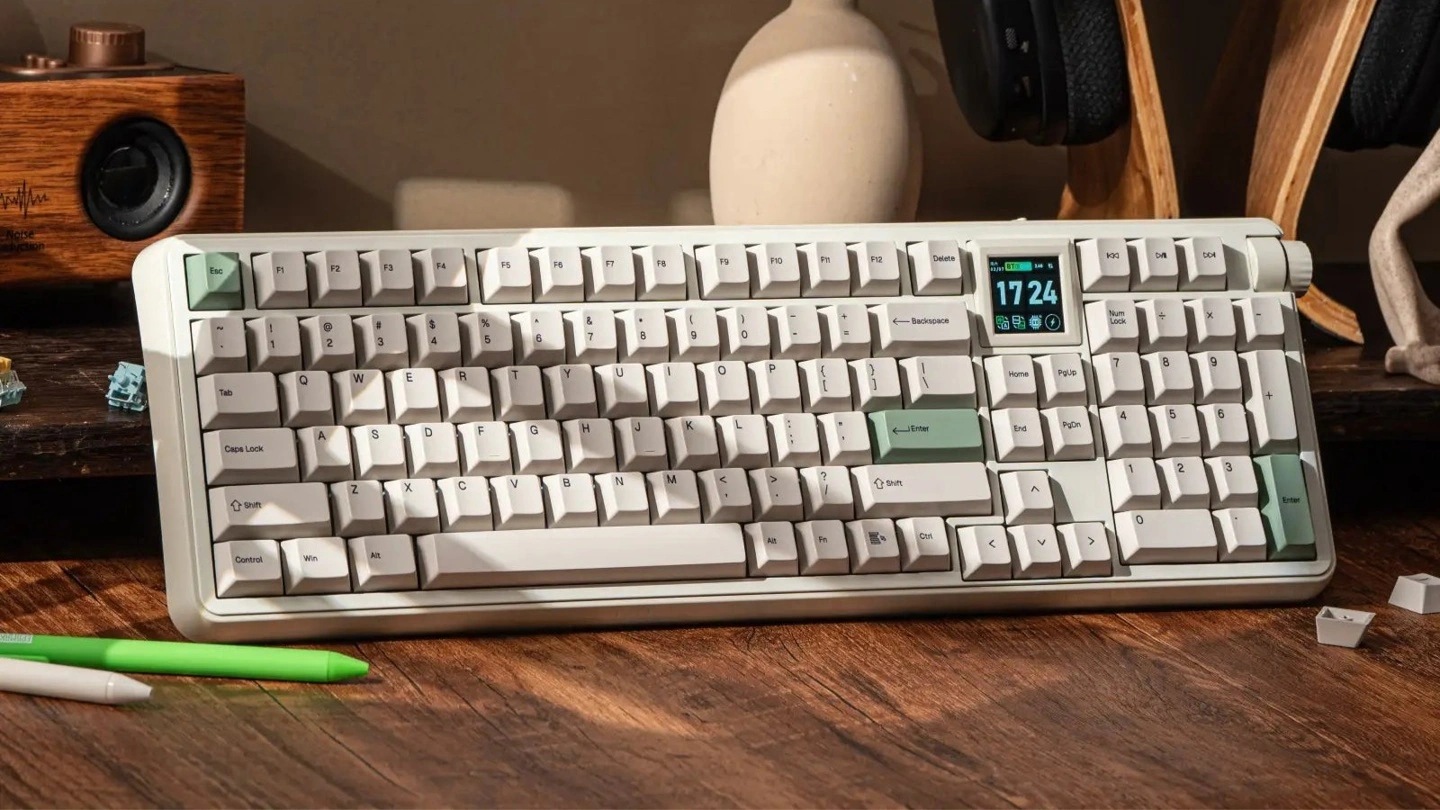
EPOMAKER launches the RT100 PRO mechanical keyboard with a removable 1.54-inch screen that swaps for four extra keys, gasket mount construction, and tri-mode connectivity at $115.99.
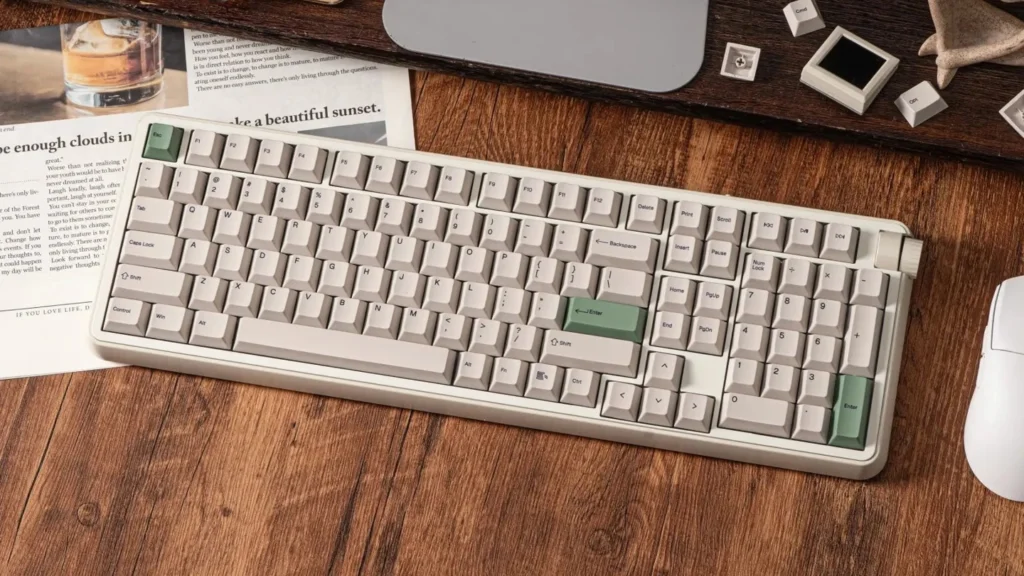
EPOMAKER just dropped the RT100 PRO on its official site, and the standout gimmick isn’t subtle—there’s a 1.54-inch square display perched in the top-right corner. Unlike most keyboard screens that exist purely for show, this one physically swaps out for four additional function keys, giving you a pseudo full-size layout without committing to the screen. The whole thing commits to a retro white aesthetic with a side-mounted rotary knob, though calling it “retro” feels generous when the design looks more like a mashup of 1980s office equipment and modern RGB excess.
The chassis uses ABS plastic, measuring 20mm tall at the front and 32mm at the rear—a subtle incline that won’t require a wrist rest for most people. EPOMAKER offers two factory switch options: Cloud Jade (a tactile) or Sea Salt Silent. Yes, it’s a linear—the name gives it away. Both sit in a polycarbonate plate held by a gasket mount structure, which theoretically provides some flex and dampening. The company claims five layers of sound-absorbing foam inside, though I’m skeptical about how much that matters when you’re typing on an ABS case instead of aluminum or polycarbonate. After years of testing keyboards with inflated foam layer counts, I’ve learned that material density beats sheer quantity every time.
Hot-Swap Switches and South-Facing RGB
What caught my attention is the hot-swappable socket design paired with south-facing RGB LEDs. South-facing placement avoids interference with Cherry-profile keycaps, a frustrating issue that still plagues cheaper boards as of March 2025. The keycaps themselves are dye-sublimated PBT in OEM profile, which should resist shine longer than the usual ABS doubleshots you see on budget options. EPOMAKER includes a 5000mAh battery (comically oversized for a keyboard this compact), but the company rates it for extended wireless use across three connectivity modes: USB-C wired, 2.4GHz wireless, and Bluetooth 5.0.
Tri-Mode Connectivity With Massive Battery
Polling rates split depending on your connection method. With wired or 2.4GHz connections, expect 1000Hz—crucial if you’re gaming or just hate input lag during fast typing. Bluetooth 5.0, meanwhile, maxes out at 125Hz, a limitation baked into the Bluetooth spec itself rather than EPOMAKER cheaping out. On the flip side, 125Hz is plenty for office work or casual browsing—most people won’t notice the difference unless they’re playing competitive shooters over Bluetooth, which is a terrible idea anyway.
I tested a similar swappable-module design on the Epomaker TH80 Pro last year, and the magnetic connectors loosened after about four months of daily swaps. If EPOMAKER fixed that issue here, the RT100 PRO becomes genuinely practical—if not, it’s a gimmick with a three-month shelf life.
The Removable Screen: Gimmick or Game-Changer?
Here’s the odd part: swapping the screen module for four physical keys fundamentally changes the keyboard’s identity. With the display installed, you get weather widgets, system stats, or custom animations—useful if you’re into that aesthetic, pointless if you just want to type. Pull the screen out, snap in the included keycap set, and suddenly you’ve got a near-full-size board with dedicated media controls or macro keys. I can’t think of another keyboard that offers this level of modularity at the $115.99 price point, which EPOMAKER lists on its US storefront right now. Keychron’s Q series starts around $165 and doesn’t include swappable display options.
Here’s what the spec sheet won’t tell you: the 1.54-inch screen runs at 240×240 resolution—identical to cheap smartwatches. That’s fine for system stats or weather widgets, but custom animations will look pixelated compared to the smoother displays on premium boards like the Keychron Q1 HE or ASUS ROG Azoth. EPOMAKER doesn’t advertise refresh rates either, so expect stuttery GIF playback at best.
Honestly, I think EPOMAKER is solving a problem that doesn’t exist. Most people will either leave the screen installed forever (making the modularity pointless) or swap it once, realize the keycaps feel mismatched, and never touch it again. The only users who benefit are streamers who want system stats on display during streams but need macro keys for editing sessions—a tiny niche that doesn’t justify the engineering cost.
The gasket mount is where things get murky. Budget gasket implementations often use stiff gaskets or shallow grooves, which defeats the purpose of the design. Without hands-on testing, it’s impossible to know if the RT100 PRO delivers actual typing flex or just marketing flex. The same goes for the five-layer foam stack—does it genuinely reduce hollowness, or is it filler material sandwiched between thin sheets? EPOMAKER’s spec page doesn’t clarify foam density or gasket hardness, which matters more than layer count.
The rotary knob sits on the left edge, presumably for volume control or layer switching. Side-mounted knobs avoid the clutter of top-right placement but feel awkward if you’re used to reaching upward for media controls. It’s a design trade-off that’ll either click immediately or annoy you forever—no middle ground.
EPOMAKER ships the RT100 PRO now at $115.99, positioning it below Keychron’s mainstream offerings but above no-name Amazon boards that cut corners on stabilizers and keycap quality. If the gasket mount holds up and the screen swap mechanism works smoothly, the EPOMAKER RT100 PRO could be the most versatile budget keyboard of Q1 2025. If not, you’re stuck with a mediocre ABS case and a gimmick that breaks after three months.
Questions and Answers
Yes, the 1.54-inch square display physically detaches and swaps for four additional function keys. This lets you toggle between a display-focused layout and a pseudo full-size keyboard depending on your workflow needs.
The keyboard ships with either Cloud Jade tactile switches or Sea Salt Silent linear switches, both hot-swappable. You can replace them with any three-pin or five-pin mechanical switch without soldering.
EPOMAKER doesn’t publish specific battery life figures, but a 5000mAh cell should last weeks on Bluetooth 5.0 with moderate RGB use. Wired and 2.4GHz modes drain faster due to 1000Hz polling rates.
Yes, the keyboard supports macOS, Windows, and Linux via USB-C, 2.4GHz wireless, or Bluetooth 5.0 connectivity. You’ll need to remap keys using EPOMAKER’s configuration software for optimal Mac compatibility, swapping Command and Option to match Apple’s layout. The function row works out of the box, but media keys may require manual binding.
The PRO model adds the removable screen module, upgraded gasket mount structure, and five-layer sound dampening. The original RT100 uses a fixed top-mount design without swappable components.
The 1000Hz polling rate over USB-C and 2.4GHz makes it viable for gaming, though the ABS case and south-facing RGB LEDs prioritize typing comfort over competitive FPS performance. Hot-swap sockets let you install faster linear switches if needed.
Sources: EPOMAKER official
Subscribe!
Subscribe to our newsletter and be in touch with high-tech news
Top Read
A LEGO game wants RTX 3080: Why LEGO Batman’s system requirements shock everyone

MSI launches XpertStation WS300 with Nvidia GB300 Blackwell: up to 496GB RAM and supercomputer hardware in desktop format

Cooler Master’s G360 Dragon Shadow SE Puts an Infinity Mirror on Your CPU Block for $66
Intel Core Ultra 7 270K Plus and Core Ultra 5 250K Plus: 24 Cores, 5.5 GHz, $299

ASUS ProArt KD300 review: compact mechanical keyboard for creators