The latest GPU-Z release quietly reveals NVIDIA's full RTX Pro Blackwell workstation stack and a revised China-market RTX 5090 D before either has been formally detailed.
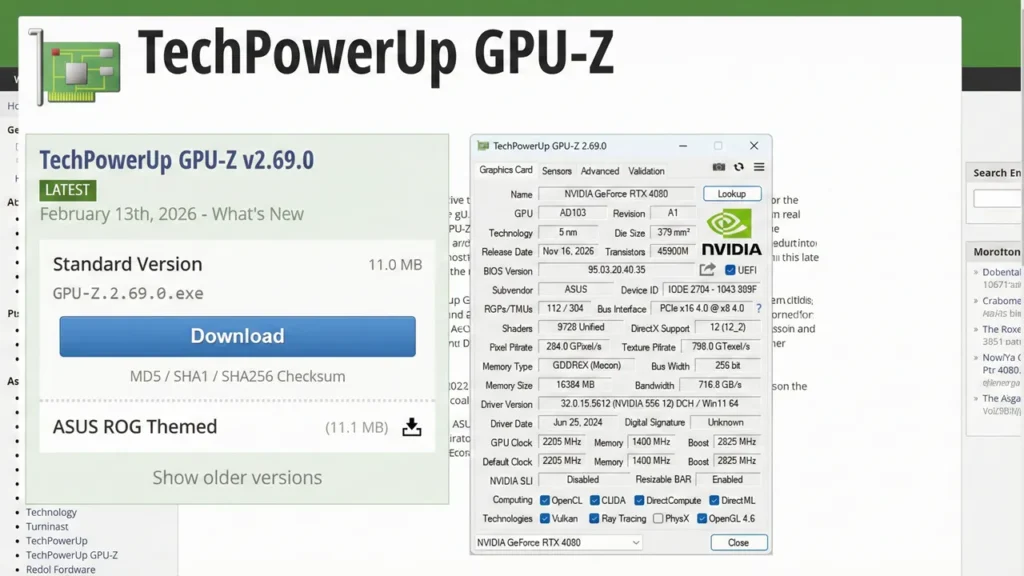
TechPowerUp’s GPU-Z has a long history of spoiling hardware announcements before manufacturers are ready, and version 2.69 continues that tradition with a support list that reads like a roadmap leak. The update — released in early 2026 — adds detection for over 18 new GPU variants spanning NVIDIA’s consumer and professional lines, AMD’s budget Radeon tier, Intel’s embedded Arc series, and China’s Moore Threads S30, a domestically designed GPU that most Western users have never encountered. For a lightweight diagnostic utility that hasn’t changed its core UI since roughly 2007, GPU-Z remains one of the most reliable leading indicators of what’s actually shipping (or about to ship) in the GPU market.
The headline additions fall into four distinct categories, and each one tells a different story about where the graphics industry is headed in the second half of 2026. NVIDIA dominates the changelog with consumer, professional, and region-specific variants; AMD fills in budget gaps that have been empty for months; Intel continues its quiet embedded push; and Moore Threads signals that China’s domestic GPU effort hasn’t stalled despite U.S. export restrictions tightening through 2025.

RTX 5090 D V2 Confirms a Second China-Market Revision
The most eyebrow-raising entry in GPU-Z 2.69’s support list is the GeForce RTX 5090 D V2 — a designation that confirms NVIDIA has already revised its China-export variant of the flagship Blackwell consumer GPU. The original RTX 5090 D shipped as a compliance-trimmed version designed to meet U.S. export control thresholds, with reduced CUDA core counts and memory bandwidth caps compared to the unrestricted RTX 5090 sold in other markets. A “V2” revision this quickly after launch typically means one of two things: either NVIDIA adjusted the hardware to comply with updated export rules from the Bureau of Industry and Security, or the company optimized the silicon binning process to improve yields on the restricted SKU.
Having tracked NVIDIA’s China-market GPU variants since the original RTX 4090 D appeared in late 2023, the V2 pattern feels more regulatory than commercial. Washington tightened compute density thresholds twice during 2025, and each adjustment forced NVIDIA to re-spec its China offerings — a rolling compliance headache that GPU-Z’s database quietly documents with each new entry. The RTX 3050 A Mobile also appearing in this update follows the same logic: a region- or OEM-specific variant that exists because global GPU distribution has become a regulatory maze rather than a simple supply chain.
NVIDIA’s Full RTX Pro Blackwell Workstation Stack Revealed
GPU-Z 2.69 adds support for eight RTX Pro Blackwell variants, and the sheer breadth of the lineup — from the RTX Pro Blackwell 5000 down to the RTX Pro Blackwell 500 — confirms that NVIDIA’s professional GPU rebrand is far more extensive than the company has publicly detailed. The naming scheme abandons the old Quadro-era numbering (RTX A4000, A5000) in favor of a tiered approach that mirrors the consumer GeForce stack: 5000 for flagship workstation use, 4500/4000 for mid-range CAD and visualization, 2000/1000 for entry-level professional certification, and 500 for basic multi-display office configurations.
What caught my attention is the inclusion of both SFF and Embedded variants alongside standard desktop and mobile SKUs. The RTX Pro Blackwell 4000 SFF targets small-form-factor workstations — a growing segment driven by studios and engineering firms replacing tower machines with compact nodes — while the RTX Pro Blackwell 5000 Embedded aims at industrial and medical imaging applications where GPU compute runs inside sealed, fanless enclosures. NVIDIA hasn’t published official specs for most of these models, so GPU-Z’s device ID entries represent the first concrete evidence that the full product matrix is locked and silicon is reaching validation stages. For IT departments planning workstation refresh cycles, this list is more useful than anything NVIDIA’s professional sales team has shared publicly.
Moore Threads S30 and the Quiet Expansion of Chinese GPUs
The Moore Threads S30 addition deserves more attention than it’ll get in most English-language coverage. Founded in 2020 by former NVIDIA China chief Zhang Jianzhong, Moore Threads has been building x86-compatible GPUs designed specifically for the Chinese domestic market — targeting government, enterprise, and data center buyers who need alternatives to restricted NVIDIA and AMD hardware. The S30 appears to be a successor or variant of the company’s MTT S80 series, which offered roughly GTX 1060-class performance when it launched in 2022 alongside a custom MUSA architecture that intentionally avoided dependencies on Western IP.
GPU-Z adding Moore Threads support signals that these GPUs are reaching a maturity level where standard Western diagnostic tools need to account for them — either because evaluation units are circulating outside China, or because the installed base has grown large enough that TechPowerUp’s user telemetry flagged the gap. Neither scenario is trivial. Four years ago, the idea that a Chinese-designed GPU would appear in GPU-Z’s database alongside GeForce and Radeon entries would have seemed premature; today it reflects a supply chain bifurcation that’s reshaping the global semiconductor landscape in real time.
AMD and Intel Round Out the Budget and Embedded Tiers
On the AMD side, GPU-Z 2.69 adds support for the Radeon RX 7400, Radeon 820M, Radeon Pro W6600X, Radeon Pro W7800, and Radeon Pro V710. The RX 7400 fills a gap that AMD’s consumer lineup has desperately needed — a true sub-$200 RDNA 3 card for budget builders who can’t justify the RX 7600’s $250+ street price. The Radeon Pro additions suggest AMD continues pushing into the professional visualization market, though the W6600X’s appearance (based on older RDNA 2 architecture) indicates that some workstation OEMs still need driver-certified options for legacy compute workflows.
Intel’s entries — the Arc A380E and Arc A310E — carry the “E” suffix that designates embedded and industrial variants, joining Intel’s quiet push into digital signage, kiosk, and edge computing applications where discrete GPU capability matters but gaming performance doesn’t. These aren’t the Arc GPUs that Intel wants headlines about, but they represent steady revenue from design wins that don’t depend on consumer sentiment or Steam hardware surveys.
Beyond new GPU support, version 2.69 fixes a shader count calculation bug affecting certain AMD and Intel GPUs — a correction that matters for anyone using GPU-Z to verify hardware specifications before purchasing used cards, where misreported shader counts could mask a partially disabled die. Updated device IDs for NVIDIA’s older Quadro P1000, Quadro P2000, and RTX 6000 round out the maintenance work, along
Version 2.69 adds detection for over 18 new GPU variants including the GeForce RTX 5090 D V2 (China-market revision), eight RTX Pro Blackwell workstation models (5000, 4500, 4000, 4000 SFF, 5000 Mobile, 5000 Embedded, 2000, 1000, and 500), AMD’s Radeon RX 7400, Radeon 820M, multiple Radeon Pro cards, Intel Arc A380E and A310E embedded variants, and China’s Moore Threads S30. The update also refreshes device IDs for older NVIDIA Quadro P1000, P2000, and RTX 6000 professional GPUs.
The RTX 5090 D V2 is a revised version of NVIDIA’s China-export GeForce RTX 5090, designed to comply with U.S. Bureau of Industry and Security export restrictions that limit compute density in GPUs shipped to China. The “V2” designation indicates a hardware revision — likely responding to tightened export thresholds during 2025 — with adjusted CUDA core counts or memory bandwidth compared to the original RTX 5090 D. These region-specific variants have become standard practice for NVIDIA since the RTX 4090 D launched in late 2023, reflecting ongoing regulatory pressure on advanced semiconductor exports.
Moore Threads is a Chinese GPU manufacturer founded in 2020 by Zhang Jianzhong, a former head of NVIDIA’s China operations, building domestically designed GPUs based on their proprietary MUSA architecture. The S30’s inclusion in GPU-Z suggests these chips have reached sufficient market penetration or evaluation-stage distribution that Western diagnostic tools need to support them. Moore Threads primarily targets Chinese government, enterprise, and data center customers seeking alternatives to export-restricted NVIDIA and AMD hardware, and the company represents one of several domestic semiconductor efforts accelerated by U.S.-China technology restrictions.
The update corrects a shader count calculation error that affected certain AMD and Intel GPUs, which could display incorrect hardware specifications — a particularly relevant fix for anyone verifying used GPU purchases where disabled shader units might indicate a lower-tier or damaged die. TechPowerUp also fixed a clock frequency reporting bug that triggered errors under specific conditions, along with multiple unspecified minor fixes. Updated device IDs for NVIDIA’s Quadro P1000, Quadro P2000, and RTX 6000 ensure accurate identification of these older professional cards under current driver versions.
The eight RTX Pro Blackwell models represent NVIDIA’s complete next-generation professional workstation GPU lineup, replacing the previous RTX Ada generation professional cards. The stack spans from the flagship RTX Pro Blackwell 5000 for high-end visualization and simulation workloads down to the RTX Pro Blackwell 500 for basic professional multi-display setups, with specialized SFF (small form factor), Mobile, and Embedded variants targeting compact workstations, laptops, and industrial applications respectively. NVIDIA hasn’t published full specifications for most of these models, making GPU-Z’s device ID entries the first public confirmation of the complete product matrix.
Sources: TechPowerUp GPU-Z, WCCFtech
Subscribe!
Subscribe to our newsletter and be in touch with high-tech news
Top Read
A LEGO game wants RTX 3080: Why LEGO Batman’s system requirements shock everyone

MSI launches XpertStation WS300 with Nvidia GB300 Blackwell: up to 496GB RAM and supercomputer hardware in desktop format
Cooler Master’s G360 Dragon Shadow SE Puts an Infinity Mirror on Your CPU Block for $66
EPOMAKER RT100 PRO Ships With a Screen You Can Rip Out for Extra Keys

Intel Core Ultra 7 270K Plus and Core Ultra 5 250K Plus: 24 Cores, 5.5 GHz, $299
