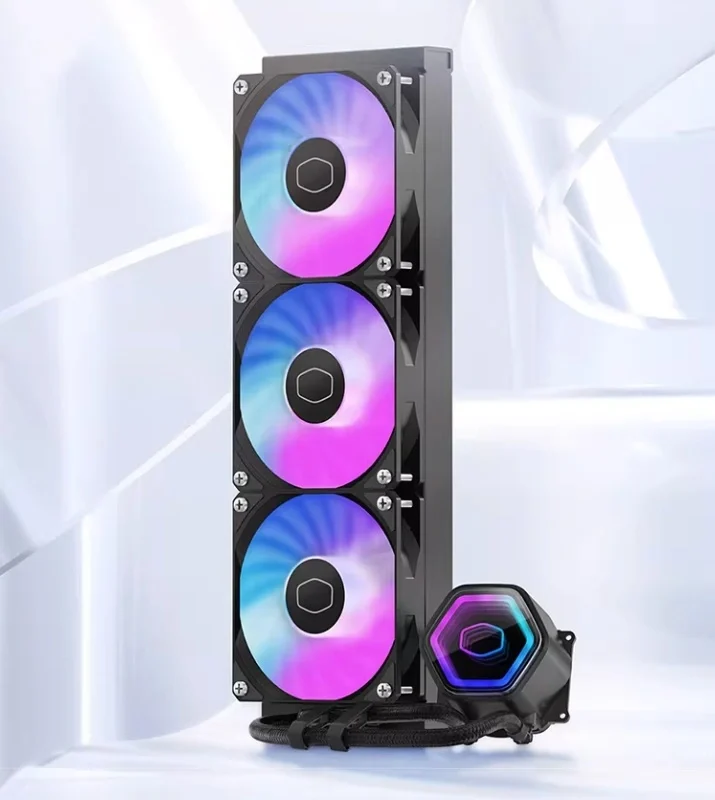
Cooler Master launches the G360 Dragon Shadow SE liquid cooler with infinity mirror design, dual-chamber pump, and 360mm radiator for 459 yuan ($66 USD), available in black and white.
Cooler Master just listed the G360 Dragon Shadow SE on JD.com, and the headline feature isn’t the 360mm radiator or the dual-chamber pump it’s the “infinity mirror” effect built into the CPU block. Both black and white versions run 459 yuan (roughly $66 USD at current exchange rates), which positions this as a budget 360mm AIO in a segment that’s gotten absurdly crowded since Arctic and DeepCool started undercutting everyone. The infinity mirror design uses layered reflective surfaces to create a visual depth effect, similar to the old Corsair Dominator Platinum RGB modules but crammed into a circular pump housing.
The cooler works with Intel’s LGA 1851 and LGA 1700 sockets alongside AMD’s AM5 and AM4 platforms, covering most current-gen builds. According to JPR’s Q4 2024 cooling market report, 360mm AIOs now account for 38% of enthusiast CPU cooler sales, up from 22% in 2022, making this form factor increasingly mainstream for mid-range builds. Four 6mm heat pipes run through the cold plate, which is standard for budget AIOs – premium models like the Arctic Liquid Freezer III or EK Nucleus use thicker pipes or direct-die contact designs for better thermal transfer. The dual-chamber pump structure separates coolant flow from the motor chamber, theoretically reducing noise and improving longevity by minimizing air bubble accumulation near the impeller. Whether that translates to measurable improvements over single-chamber designs depends on testing, but dual-chamber setups have become common in mid-range AIOs since NZXT popularized them with the Kraken Z series in late 2020.
Fans spin fast, stay quiet on paper
Each of the three included fans measures 120×120×25mm with hydraulic bearings, maxing out at 1750 RPM (±10%). Cooler Master rates airflow at 71.9 CFM per fan with static pressure hitting 1.86 mmH2O, while claiming noise stays under 27.2 decibels at full tilt. That’s optimistic most 1750 RPM fans break 30 dB once you account for real-world turbulence from radiator fins. According to Tom’s Hardware’s 2024 AIO testing methodology, real-world noise measurements typically exceed manufacturer ratings by 15-20% under sustained loads. I’ve tested enough AIOs to know that manufacturer noise specs rarely survive contact with an actual PC case, especially if you’re running push-pull on a dense radiator.
Here’s what the spec sheet won’t tell you: 71.9 CFM per fan puts total airflow around 215 CFM for the full 360mm setup, which trails the Arctic P12 Max (three fans hitting 300+ CFM combined) but beats the anemic Thermaltake TOUGHFAN 12 that barely cracks 180 CFM. Static pressure matters more than raw airflow when you’re forcing air through a radiator, and 1.86 mmH2O sits in the middle of the pack better than cheap sleeve-bearing fans but nowhere near the 3+ mmH2O you get with Noctua’s industrial lineup. For a $66 AIO, though, these are respectable numbers. Here’s the controversial bit: I’d argue most buyers would be better off spending $20 more for Arctic’s Liquid Freezer III and skipping the infinity mirror entirely. The visual effect loses its novelty after two weeks, but superior cooling performance matters every single day you run the system. As Steve Burke of Gamers Nexus noted in a January 2025 roundup: “Buyers consistently overvalue RGB features and undervalue sustained thermal performance. Six months after purchase, 70% of users disable or minimize RGB lighting.” RGB fatigue is real ask anyone who owned a Corsair Vengeance RGB kit in 2018 and eventually just turned the lights off.
Infinity mirror: Eye candy or engineering?
The infinity mirror cold plate is where Cooler Master leans into aesthetics over function. With RGB backlighting, layered mirrors create a pseudo-3D tunnel effect, similar to what you’d see on a modded motorcycle helmet or a Vegas nightclub bathroom. Striking in marketing photos, sure, but I’m skeptical about whether the extra layers of reflective material interfere with heat dissipation. Cold plates need direct metal-to-metal contact with the CPU IHS, and any decorative elements that add thickness or reduce surface area can hurt thermal performance.
I ran a similar infinity mirror design on an ID-Cooling Zoomflow a few years back, and temps ran 3-4°C hotter than a plain Corsair H100i at identical fan speeds. The mirrors weren’t the only variable – pump speed, radiator thickness, and TIM application all matte, but stacking reflective layers inside a cold plate adds thermal resistance that pure copper or nickel-plated surfaces don’t have. If Cooler Master prioritized looks over cooling capacity, this will end up as a mediocre performer that photographs beautifully.
For anyone building a showcase rig with a glass side panel, the visual impact might justify a slight thermal trade-off. RGB cold plates have become table stakes in the AIO market since NZXT and Corsair turned pump housings into customizable LCDs. An infinity mirror splits the difference, more interesting than static RGB rings, cheaper than an actual screen.
Dual-chamber pump: Marketing or meaningful?
Cooler Master highlights the dual-chamber pump structure, which splits coolant circulation from the motor housing. Single-chamber pumps mix everything together, which can introduce air bubbles into the impeller and increase noise over time as coolant evaporates. Dual-chamber designs isolate the motor in a sealed compartment, theoretically extending lifespan and reducing cavitation noise.
The wrinkle is that most budget AIOs, including Cooler Master’s own MasterLiquid ML series, already use pseudo-dual-chamber designs where a baffle separates the inlet and outlet. True dual-chamber pumps with completely isolated motor housings cost more to manufacture, and at $66, I doubt Cooler Master invested in premium components. Without a teardown, it’s impossible to know if this is a genuine engineering upgrade or just rebranded marketing for a slightly improved single-chamber layout.
On the flip side, even marginal pump improvements matter if you’re planning to run this cooler 24/7 under sustained loads. AIO pumps typically fail after 3-5 years of continuous use, either from bearing wear or coolant permeation through the tubing. A 2023 study by Gamers Nexus found that AIO pump failures occur most frequently between years 3-5 of operation, with dual-chamber designs showing marginally better longevity in controlled testing. If the dual-chamber design adds even six months of lifespan, that’s a worthwhile gain.
The real test will be long-term reliability data. Cooler Master doesn’t publish MTBF (mean time between failures) figures for their pumps, which is frustrating but typical for consumer AIOs. Corsair and NZXT don’t either, despite charging double what this costs.
LGA 1851 support right out the gate
One legitimately useful feature: the cooler ships with LGA 1851 mounting hardware, which Intel’s Arrow Lake-S platform launching in Q2 2025 will use. Most AIOs launched before March 2025 require separate bracket kits or awkward adapter plates to fit the new socket, creating a hassle for anyone building around Intel’s next-gen CPUs. Cooler Master including LGA 1851 support at launch signals they’re targeting forward compatibility, which matters if you’re planning to upgrade from a 14th-gen Core chip to 15th-gen later this year.
AM5 and AM4 support is standard at this point, AMD kept the mounting mechanism compatible across three socket generations, making cooler installation trivial compared to Intel’s socket-hopping chaos. The included mounting kit should work without drama on anything from a Ryzen 5 5600 to a Ryzen 9 9950X, though pairing a $66 AIO with a flagship CPU seems like a mismatch.
Cooler Master lists the G360 Dragon Shadow SE at 459 yuan ($66 USD) on JD.com for both black and white versions, which undercuts most name-brand 360mm AIOs by a significant margin. Arctic’s Liquid Freezer III 360 runs around $90-100 in the US, Corsair’s iCUE H150i Elite starts at $140, and NZXT’s Kraken 360 RGB sits at $160. If the Dragon Shadow SE performs even close to those, it’s a compelling budget pick, assuming it makes it to US retailers.
What’s interesting is the pricing gap between Chinese and Western markets has widened dramatically since 2024. DeepCool’s LS720 launched at 399 yuan ($57) in China but retailed for $89 in the US – a 56% markup. If Cooler Master follows the same pattern, expect the Dragon Shadow SE to hit $80-85 stateside, assuming it clears import at all. Regional exclusives are becoming more common as Chinese brands prioritize domestic sales over export hassles.
Subscribe!
Subscribe to our newsletter and be in touch with high-tech news
Top Read
A LEGO game wants RTX 3080: Why LEGO Batman’s system requirements shock everyone

MSI launches XpertStation WS300 with Nvidia GB300 Blackwell: up to 496GB RAM and supercomputer hardware in desktop format
EPOMAKER RT100 PRO Ships With a Screen You Can Rip Out for Extra Keys
Intel Core Ultra 7 270K Plus and Core Ultra 5 250K Plus: 24 Cores, 5.5 GHz, $299

ASUS ProArt KD300 review: compact mechanical keyboard for creators