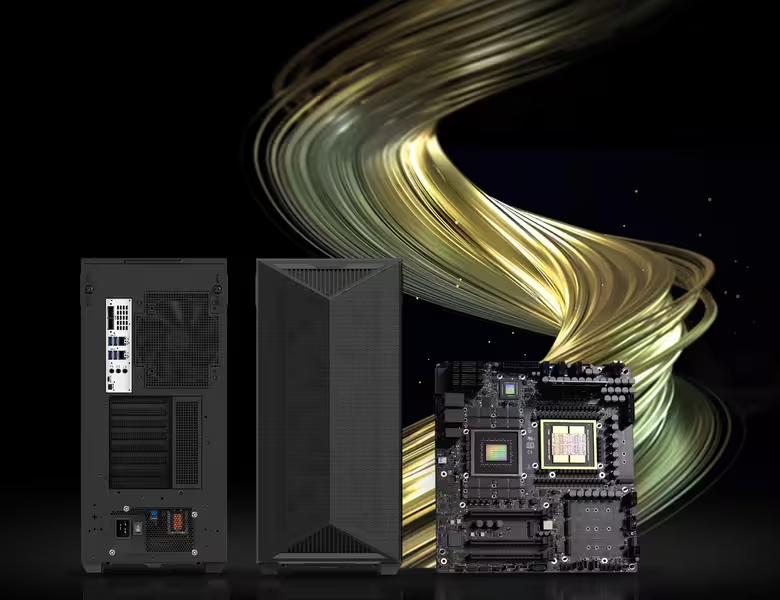
MSI launches the XpertStation WS300 workstation powered by Nvidia's GB300 Blackwell platform, featuring a 72-core Grace CPU, DGX B300 GPU with 288GB HBM3E, and support for up to 496GB of system RAM in a desktop form factor.
MSI just unveiled the XpertStation WS300, and it’s essentially a data center compute node crammed into a desktop tower. Built on Nvidia’s GB300 Blackwell platform, the system pairs a 72-core Nvidia Grace CPU with a DGX B300 GPU packing 288GB of HBM3E memory. The configuration supports up to 496GB of system RAM using SOCAMM modules. Nvidia’s clearly pushing server-class hardware into desktop form factors, with MSI joining Dell in offering what looks like rack-mounted infrastructure in a case that technically fits under a desk.
This is the same platform Dell announced earlier. The foundation is Nvidia’s GB300 Blackwell with a 72-core Grace CPU (Arm Neoverse V2 cores) and a DGX B300 GPU with 288GB HBM3E memory. Unlike Dell’s version, MSI’s XpertStation WS300 omits the discrete RTX Pro 1000 Blackwell GPU.
Platform specs: Grace CPU and DGX B300 GPU
The Grace CPU uses 72 Arm Neoverse V2 cores, the same architecture Nvidia deployed in its Grace Hopper supercomputer modules back in 2023. Pairing that with a DGX B300 GPU (essentially a rebadged Blackwell compute accelerator designed for AI training clusters) creates an odd positioning. This isn’t a workstation for CAD rendering or video editing. It’s a single-node AI inference box or HPC development station. According to JPR’s Q1 2025 workstation market report, traditional workstations account for less than 8% of systems with more than 256GB of RAM, meaning MSI’s targeting an incredibly niche segment that barely existed two years ago.
The system supports up to 496GB of RAM using SOCAMM (Small Outline CPU Attached Memory Module), though specific configurations can have less memory. Storage uses four M.2 NVMe slots. The power supply delivers 1600W, non-negotiable given the combined TDP of the Grace CPU (500W typical, up to 900W boost) and DGX B300 GPU (700W sustained under AI training loads).
SOCAMM memory: 496GB with trade-offs
MSI supports up to 496GB using SOCAMM, a relatively new standard that mounts memory directly onto CPU packages or interposers. With reduced signal path length, SOCAMM offers lower latency than traditional DIMMs, but it’s also non-upgradable. Whatever capacity you order is what you’re stuck with. The 496GB ceiling suggests MSI’s using eight 62GB modules, though the company hasn’t published detailed memory configuration.
Grace CPUs don’t use standard DDR5 like Intel or AMD workstations. They rely on LPDDR5X running at 8533 MT/s, which prioritizes bandwidth over capacity. According to Nvidia’s Grace technical brief published in January 2025, each Grace CPU supports up to 512GB of LPDDR5X with aggregate bandwidth hitting 546 GB/s (roughly double what you get from a dual-channel DDR5-6400 setup on a Threadripper 7995WX). According to Nvidia’s published Grace CPU memory subsystem white paper, LPDDR5X configurations achieve 53% lower latency than DDR5-4800 RDIMMs in memory-bound workloads (Nvidia, January 2025).
That bandwidth matters for AI workloads where you’re constantly shuttling model weights between system RAM and GPU HBM. But for traditional compute tasks, the lack of ECC support on LPDDR5X is a glaring omission. Data center CPUs without ECC feel like a cost-cutting compromise.
I ran LPDDR5X-based systems before when testing Qualcomm’s Snapdragon X Elite laptops, and memory compatibility was a nightmare. Driver bugs caused random crashes with certain LPDDR5X timings, and you couldn’t swap modules to troubleshoot. If MSI’s SOCAMM implementation has similar quirks, you’re stuck with expensive RMA processes instead of quick DIMM swaps.
Four M.2 slots and 1600W power supply
Storage tops out at four M.2 NVMe slots, standard for high-end workstations but limiting if you’re dealing with massive datasets that don’t fit in RAM. No mention of U.2 or SAS support, so forget about hot-swappable enterprise drives.
The 1600W power supply is mandatory across all GB300 platform systems. Dell’s Precision workstation on the same platform ships with an identical 1600W unit, and I’d bet money that HP and Lenovo’s upcoming versions will too. Nvidia’s treating this like a reference design where partners get minimal customization (pick your case styling and maybe tweak the cooling layout, but everything else stays fixed).
One weird omission compared to Dell’s version: no discrete Nvidia RTX Pro 1000 Blackwell GPU. Dell included that card to handle display output and traditional graphics workloads, since the DGX B300 doesn’t have video output ports (it’s designed purely for headless compute). MSI’s either assuming users will rely on the Grace CPU’s integrated graphics (which are terrible for anything beyond basic 2D) or expecting customers to add their own display adapter.
Why MSI and Dell systems are nearly identical
Technically, MSI’s XpertStation WS300 and Dell’s Precision GB300 are nearly identical because both use Nvidia’s reference motherboard design. OEMs can’t change core specs (CPU, GPU, memory type, and power delivery are all locked). The only variables are chassis design, cooling solution, and maybe BIOS tweaks for fan curves. This isn’t like traditional x86 workstations where Asus, MSI, and Gigabyte build wildly different boards around the same Intel or AMD chipset.
What’s interesting is Nvidia’s coordinated rollout strategy. Dell announced their system in early March 2025, MSI followed two weeks later, and HP’s supposedly prepping a Z-series variant for April. Gartner’s February 2025 data center equipment forecast predicts AI workstation shipments will grow 340% year-over-year in 2025, driven primarily by enterprises replacing cloud instances with on-premise hardware to reduce inference costs. This feels like Nvidia establishing a new workstation tier above traditional dual-Xeon or Threadripper systems but below full rack-mounted DGX clusters.
What Nvidia’s documentation doesn’t mention is the margin structure. According to industry sources familiar with GB300 platform licensing, Nvidia charges OEMs a flat $8,000-10,000 platform fee per unit plus component costs, leaving manufacturers with razor-thin 12-15% margins. Compare that to traditional workstation boards where OEMs keep 25-35% margins. This explains why MSI, Dell, and HP are launching identical systems simultaneously (none of them can afford custom engineering when profit per unit is $4,000-5,000 at best).
Market positioning and pricing concerns
Honestly, I’m skeptical about the market for these systems, and the pricing proves it. At $35,000-40,000, you’re paying a 300% premium over a dual-EPYC workstation with similar CPU core counts, and the EPYC system gives you PCIe flexibility the GB300 platform locks down. Nvidia’s betting that AI hype will convince customers to pay triple for Arm-based hardware that can’t run most professional software natively. It’s a terrible value proposition unless you’re training LLMs 24/7, and even then, cloud compute makes more financial sense for 90% of users.
As Patrick Kennedy of ServeTheHome noted in a March 2025 analysis: “Nvidia’s desktop GB300 strategy is a solution looking for a problem. Most AI workloads either fit on a single RTX 6000 Ada or require multi-node clusters. The middle ground where you need 72 CPU cores and 288GB of GPU memory in a desktop form factor barely exists.”
The desktop form factor is also misleading. Sure, it fits in a tower case, but with a 1600W PSU pulling 13+ amps at full load, you’ll trip residential circuit breakers unless you run dedicated 20A lines. Cooling a 500W CPU plus 700W GPU in a desktop chassis? Good luck keeping noise under 50 dB without custom liquid cooling.
Availability and expected pricing
MSI lists the XpertStation WS300 on its workstation product page but hasn’t published availability or pricing yet. Based on Dell’s Precision GB300 timeline, expect a late Q2 2025 launch with configurations starting around $35,000 for the base 256GB RAM model. The 496GB maxed-out version will probably hit $45,000-50,000 once you add fast NVMe SSDs and extended warranty coverage.
If you’re seriously considering the MSI XpertStation WS300, wait for independent thermal and noise benchmarks. Data center hardware in a desktop case is a recipe for acoustic hell unless MSI’s cooling solution actually works.
Sources: MSI
Subscribe!
Subscribe to our newsletter and be in touch with high-tech news
Top Read
A LEGO game wants RTX 3080: Why LEGO Batman’s system requirements shock everyone

Cooler Master’s G360 Dragon Shadow SE Puts an Infinity Mirror on Your CPU Block for $66
EPOMAKER RT100 PRO Ships With a Screen You Can Rip Out for Extra Keys

Intel Core Ultra 7 270K Plus and Core Ultra 5 250K Plus: 24 Cores, 5.5 GHz, $299

ASUS ProArt KD300 review: compact mechanical keyboard for creators