
Colorful's new X3D AI Turbo BIOS feature promises one-click performance gains for Ryzen 3D V-Cache chips on AM5 800 motherboards, with early Valorant benchmarks showing up to 16% improvement in frame stability.
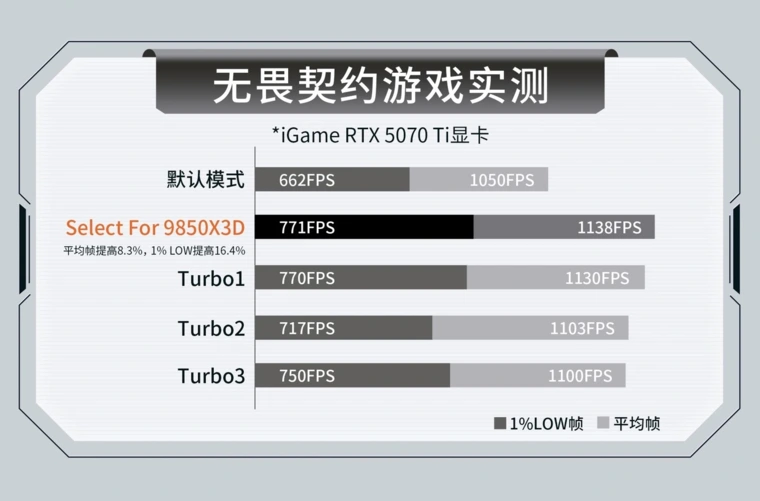
Colorful just dropped something that caught the attention of anyone running a Ryzen 3D V-Cache chip on AM5: a BIOS-level feature called X3D AI Turbo, baked into the company’s AM5 800 series motherboards. The pitch is dead simple — flip a toggle in BIOS, skip the tedious manual tuning, and walk away with noticeably higher frame rates — up to 16% in the best case. According to Colorful’s own internal testing with a Ryzen 9850X3D and an RTX 5070 Ti, we’re looking at an 8.3% bump in average FPS and a 16.4% jump in 1% lows, all in Valorant. For a feature that takes two clicks to enable, those figures would be impressive if they hold up under independent scrutiny.
What X3D AI Turbo does to your Ryzen and what it doesn’t
The concept itself isn’t entirely new. What Colorful has done is bundle an automated silicon quality assessment directly into the BIOS of its AM5 800 boards. When enabled, the motherboard evaluates how well the installed processor handles voltage and frequency at the die level, then applies a pre-configured overclock profile tailored to that specific chip’s capabilities. Think of it as a more hands-off version of what enthusiasts already do with Curve Optimizer and PBO2 on Ryzen — except without the hours of per-core stability testing that process usually demands.
The “two clicks in BIOS” framing is aimed squarely at a specific audience: the growing number of gamers who buy high-end Ryzen X3D chips but never touch overclocking because the learning curve feels too steep. I’ve spent plenty of evenings dialing in Curve Optimizer offsets core by core on a 7800X3D, and honestly — it’s the kind of tedious work that most people simply won’t bother with. If Colorful can automate that process without sacrificing stability, it fills a real gap in the AM5 ecosystem.
The valorant benchmarks: promising, with a major asterisk
Colorful’s test setup pairs the Ryzen 9850X3D with NVIDIA’s RTX 5070 Ti — a combination that already pushes extremely high frame rates in competitive esports titles. In Valorant specifically, X3D AI Turbo reportedly lifted average FPS by 8.3%, while the more telling 1% low metric jumped 16.4%. That 1% low figure is the one that decides whether your game feels smooth during chaotic firefights and particle-heavy ability spam — it matters far more than the average for ranked play.
Here’s the thing, though. Valorant is a lightweight Unreal Engine title that’s notoriously CPU-sensitive and scales well with even modest frequency bumps. Showing gains there is the easy part. A single-game benchmark on the most CPU-bound esports title on the market doesn’t tell us much about what happens in Cyberpunk 2077 at 4K, or Hogwarts Legacy, or any GPU-limited scenario where the CPU-side uplift gets buried. Until independent reviewers like Hardware Unboxed or der8auer run broader suites, these numbers need third-party validation before anyone takes them seriously. Vendor benchmarks have burned us before — remember NVIDIA’s DLSS 3 launch slides that conveniently tested at resolutions nobody uses? — and this has all the hallmarks of a cherry-picked demo.
One-Click overclocking is becoming an Arms Race
Colorful isn’t the first board maker chasing this idea. Throughout 2024 and into early 2025, MSI, ASUS, and Gigabyte have all been pushing their own automated tuning features on AM5 and Intel 700/800 series platforms. ASUS’s overclocking assistant and MSI’s Game Boost target a near-identical audience — gamers who want free performance without the manual work. The r/AMD subreddit has been skeptical about vendor auto-OC tools ever since MSI’s Game Boost bricked a few early Ryzen 9000 boards in September — so Colorful’s claim of “safe automatic tuning” is going to face an uphill battle with enthusiasts. What sets Colorful apart, at least on paper, is the explicit focus on 3D V-Cache silicon and the claim that its per-chip frequency assessment is more granular than a generic one-size-fits-all boost profile.
Credit where it’s due: the Ryzen X3D lineup thrives on careful frequency tuning in ways that standard Zen 5 chips don’t. The stacked L3 cache creates unique thermal and voltage constraints — push too hard and you get instability, too little and you leave frames on the table. A tool that accounts for per-chip variation in that narrow operating window could theoretically extract performance that blanket PBO settings miss entirely. Whether Colorful’s implementation lives up to that promise — or just slaps a mildly aggressive PBO preset on the chip with marketing polish — is something only independent testing will settle.
What Colorful isn’t telling us
A few things are missing from the announcement — and they’re the ones that matter most. There’s zero mention of thermal impact, long-term stability data, or whether enabling X3D AI Turbo affects AMD’s warranty coverage. For anyone who’s dealt with the 7800X3D’s notoriously tight thermal headroom, the lack of temperature numbers should worry you — especially if you’ve ever watched that chip hit 89°C at bone-stock settings with a decent air cooler. I’ve personally had to swap from a mid-range tower cooler to a 360mm AIO just to keep my 7800X3D from throttling under sustained gaming sessions, and any overclock, even an automated one, pushes those margins thinner.
There’s also the availability question. Colorful is primarily a Chinese market brand with limited retail presence in the US and Europe. Even if X3D AI Turbo works exactly as advertised, getting your hands on one of these AM5 800 boards stateside could be the biggest practical hurdle. No US pricing, no confirmed distribution partners, no timeline for broader availability as of early 2025 — just a feature announcement and a single Valorant benchmark.
If independent testing confirms even half of Colorful’s claimed gains across a wider set of titles, this could put real pressure on ASUS, MSI, and Gigabyte to refine their own automated tuning specifically for 3D V-Cache silicon. And that competitive pressure — not Colorful’s board itself — might end up being the biggest win for anyone running these chips in 2025.
FAQ
X3D AI Turbo is a BIOS-level feature on Colorful’s AM5 800 series motherboards that applies an optimized overclock profile to Ryzen processors with 3D V-Cache. The board evaluates the quality of the installed silicon and adjusts frequencies accordingly, targeting gaming performance gains without requiring manual overclocking knowledge.
Colorful’s internal benchmarks with a Ryzen 9850X3D and RTX 5070 Ti showed an 8.3% average FPS increase and a 16.4% improvement in 1% low FPS in Valorant. These results haven’t been independently verified yet, and gains will likely vary across different games — especially GPU-limited titles where CPU-side improvements get masked.
For most gamers, the sheer convenience makes it appealing — manual Curve Optimizer work can easily eat an entire evening of per-core testing and crash troubleshooting. Experienced overclockers who put in the time may still squeeze out slightly better results with hand-tuned settings. The real target audience is the majority of 3D V-Cache owners who never open BIOS overclocking menus at all.
Currently, the feature is confirmed exclusively for Colorful’s AM5 800 series boards. There’s been no announcement about backward compatibility with older AM5 600 series motherboards or whether a future BIOS update might extend support. Given Colorful’s limited presence outside China, availability in the US market remains unclear as of early 2025
Colorful hasn’t addressed this directly, which is a notable omission. AMD’s warranty policy generally doesn’t cover damage from overclocking, and since X3D AI Turbo applies frequency adjustments beyond stock specifications, users should assume standard overclock-related warranty caveats apply until AMD or Colorful clarifies otherwise.
Subscribe!
Subscribe to our newsletter and be in touch with high-tech news
Top Read
Cooler Master’s G360 Dragon Shadow SE Puts an Infinity Mirror on Your CPU Block for $66
Intel Core Ultra 7 270K Plus and Core Ultra 5 250K Plus: 24 Cores, 5.5 GHz, $299

ASUS ProArt KD300 review: compact mechanical keyboard for creators
ASUS Dual RTX 5070 EVO: compact 2.5-slot GPU for SFF builds
Best budget gaming CPU 2026: AMD and Intel picks under $200