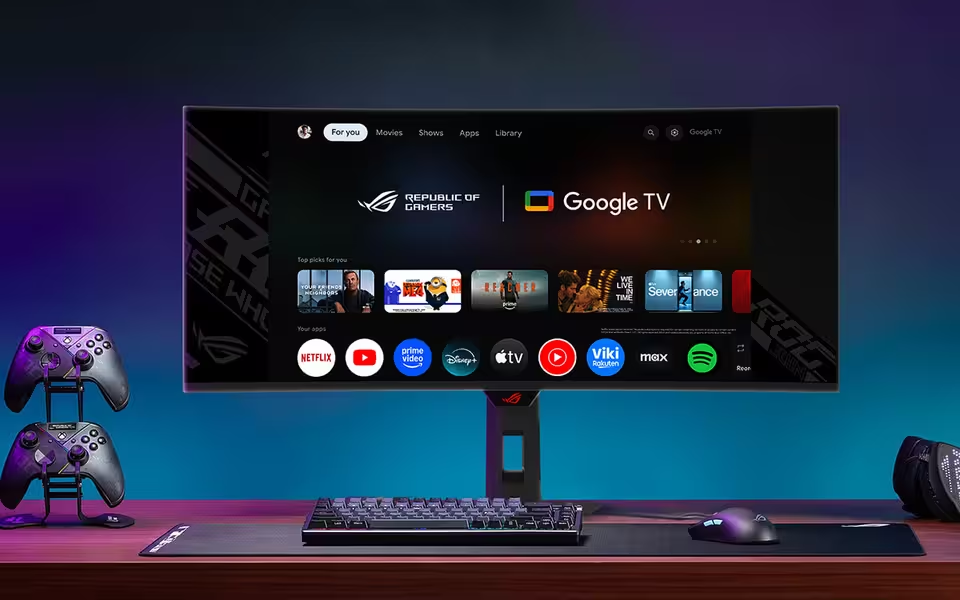
ASUS just shipped the first gaming OLED monitor with Google TV built in — and GeForce Now support means you can skip the PC entirely. Whether a last-gen panel at $1,100 makes that pitch land is another question.
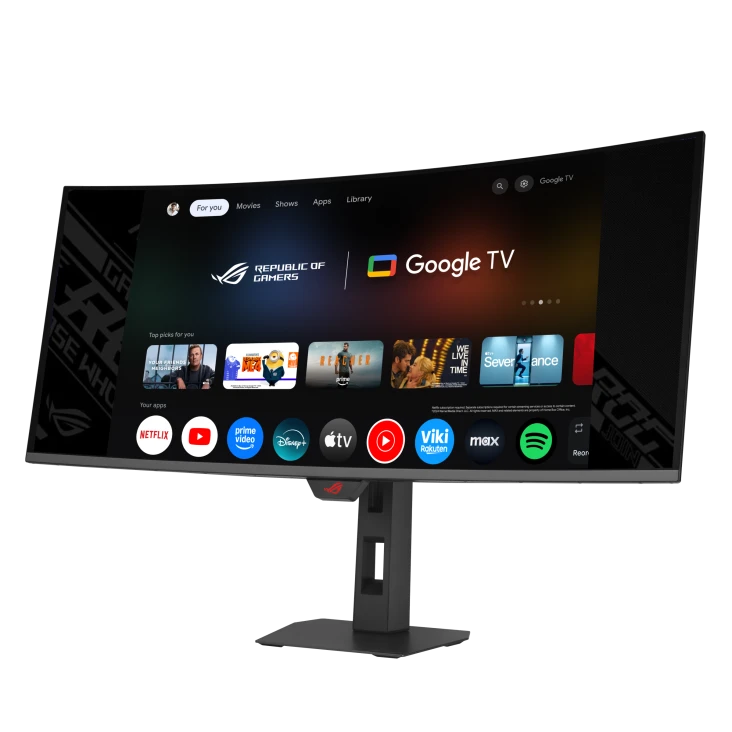
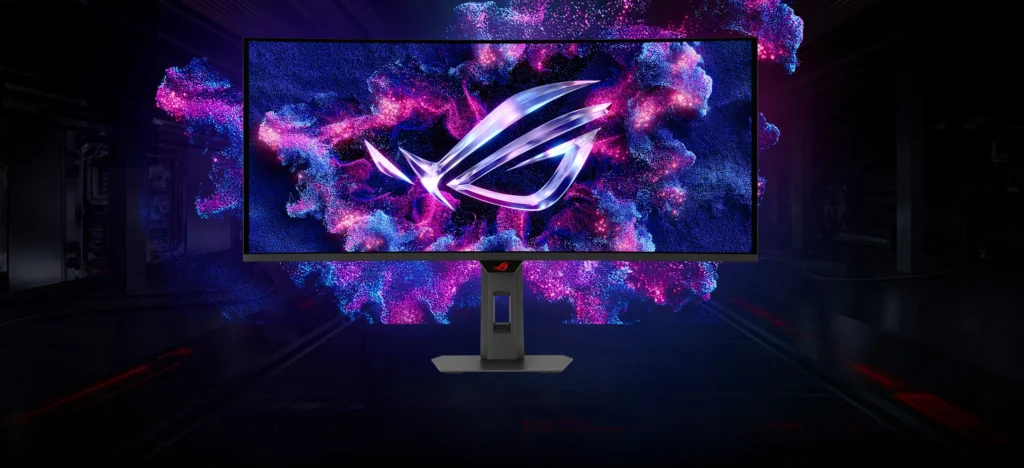
ASUS has taken an unusual swing at the gaming monitor category with the Strix OLED XG34WCDMTG — one of several ambitious ROG Strix launches the company opened 2026 with — a 34-inch QD-OLED ultrawide that ships with Google TV on Android 14 built directly into the display chassis. According to ASUS, this is the first gaming OLED monitor to integrate Google TV natively, which means it operates as a standalone smart display, streams apps, and — through NVIDIA’s GeForce Now cloud gaming service — lets you play titles like Cyberpunk 2077 or Fortnite without a gaming PC anywhere in the picture. The monitor landed at retail in early 2026 at $1,100, and it raises a genuinely interesting question: at what point does a smart monitor become a budget gaming alternative rather than a traditional PC peripheral?
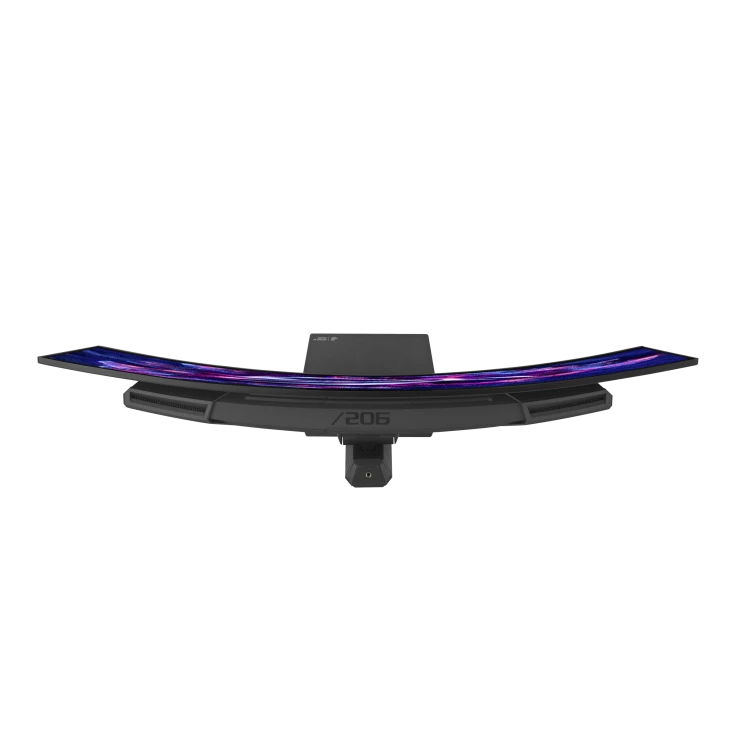
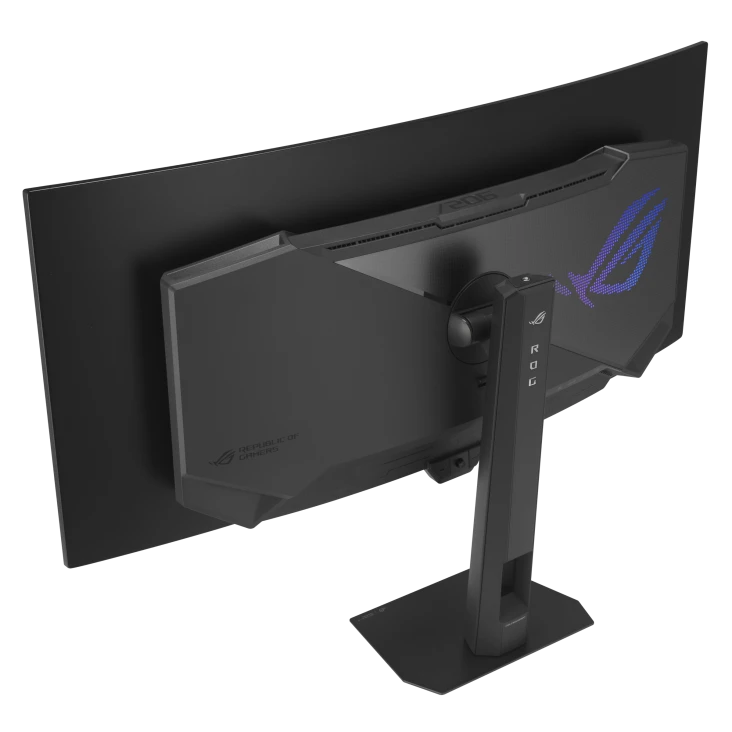
The hardware underneath runs a curved 34-inch QD-OLED panel at 3440×1440 resolution with a 240Hz refresh rate and 1800R curvature — specs that would have been cutting-edge in 2023 but sit one generation behind Samsung’s current QD-OLED panels, which now reach 360Hz at comparable sizes. Typical brightness lands at 250 nits, with a peak HDR output of 1000 nits in highlight-heavy HDR content. A built-in Wi-Fi 6 module handles the wireless connectivity that Google TV and GeForce Now demand, and two 5-watt speakers provide audio without requiring external equipment — useful for a monitor designed to operate independently of a desktop system.
Google TV on a Gaming Monitor is a Weirder idea than it sounds
Having spent years evaluating monitors across consumer and professional contexts, the combination of Google TV and a 240Hz gaming panel initially reads as a solution looking for a problem. Smart TVs have offered Google TV integration since 2020, and 34-inch ultrawide panels don’t appear in the living room configurations where Android-based streaming makes intuitive sense. Dig past the surface, though, and ASUS’s target audience comes into sharper focus: apartment dwellers who want one screen to handle gaming, Netflix, YouTube, and occasional productivity without the physical footprint or power draw of a full desktop tower. For that specific use case — a student dorm, a compact home office, or a bedroom setup where desk real estate is measured in inches — having Google TV baked into the monitor genuinely reduces the hardware required to get a functional entertainment and gaming station running.
The Android 14 foundation brings the full Google Play Store, Google Assistant integration, Chromecast built-in, and Google Home compatibility — so the XG34WCDMTG can receive casts from phones and tablets in addition to running its own apps. ASUS hasn’t published the full chip specifications powering the Android side of the device, which matters because Android TV performance has historically ranged from buttery smooth on Amlogic S905X4 silicon to frustratingly sluggish on cost-cut media chips. Until independent reviewers get hands-on time with the navigation interface under real load — switching between Google TV’s app launcher and the monitor’s gaming menu, for instance — the Android performance question mark deserves honest acknowledgment.
GeForce Now makes the “No PC” promise technically true
NVIDIA’s GeForce Now is the service that transforms the XG34WCDMTG from a novelty into a functional gaming platform. Through NVIDIA’s cloud servers, GeForce Now streams games from a remote PC running whatever GPU NVIDIA has allocated to your session — an RTX 4080 equivalent on the $20-per-month Ultimate tier — directly to the monitor via its Wi-Fi 6 connection. Games live in your existing Steam, Epic, or GOG library rather than requiring separate purchases, and NVIDIA’s server network has expanded substantially through 2025, with data centers in North America, Europe, and parts of Asia delivering sub-30ms latency for users within reasonable geographic proximity.
The catch worth stating plainly: GeForce Now requires a subscription, a strong internet connection (NVIDIA recommends 35Mbps minimum for 1440p at high framerates), and acceptance of occasional session queues on the free tier. None of those are deal-breakers for a buyer who’s already comfortable streaming 4K video, but the “no PC required” framing in ASUS’s marketing skips over the monthly cost and network dependency that replace the upfront PC investment. A $20/month GeForce Now Ultimate subscription adds $240 annually to the XG34WCDMTG’s $1,100 purchase price — context that matters when evaluating the monitor’s value against a conventional gaming monitor paired with an entry-level discrete GPU.
Where the $1,100 Price gets fifficult to defend
The XG34WCDMTG’s pricing is the place where honest assessment gets uncomfortable. Samsung’s Odyssey OLED G8 at 34 inches — using second-generation QD-OLED with improved brightness uniformity and WOLED-beating color saturation — has dropped to $900-1,000 depending on sales timing, and it runs a more refined panel than the first-gen QD-OLED cell inside the ASUS. LG’s 34GS95QE OLED ultrawide reaches similar pricing through regular promotions. Neither competitor offers Google TV, which is genuinely the XG34WCDMTG’s differentiating argument — but paying a $100-200 premium over panels with newer display technology specifically for Android 14 and GeForce Now integration assumes those features justify the gap rather than simply adding cost.
My read on this product is that ASUS has built something interesting for a narrow but real audience, then priced it as if the market is broader than it is. The “gaming monitor that replaces your PC” positioning resonates for budget-conscious setups where a tower PC genuinely isn’t viable, but the $1,100 entry point sits uncomfortably close to the cost of building a capable gaming PC around a used or budget GPU — a system that doesn’t depend on cloud subscriptions or a strong internet connection to function. ASUS would have made a more defensible product at $899; at $1,100, the Google TV integration needs to carry more weight than a single feature addition typically can.
Frequently Asked Questions
The ASUS Strix OLED XG34WCDMTG is a 34-inch QD-OLED ultrawide gaming monitor that runs Google TV on Android 14 as a built-in operating system, allowing it to function as a standalone smart display and cloud gaming device without a connected PC. ASUS claims it’s the first gaming OLED monitor with native Google TV support. Hardware specifications include a 3440×1440 resolution panel, 240Hz refresh rate, 1800R curvature, 1000-nit peak HDR brightness, built-in Wi-Fi 6, and 2x5W speakers — giving the monitor enough self-contained hardware to handle streaming, apps, and cloud gaming sessions independently.
Through NVIDIA’s GeForce Now cloud gaming service, yes — the XG34WCDMTG streams games from NVIDIA’s remote servers directly over its Wi-Fi 6 connection, playing titles from your existing Steam, Epic, or GOG library without a local gaming PC. GeForce Now requires a subscription ($10/month Priority or $20/month Ultimate for RTX 4080-class performance) and a reliable internet connection of at least 35Mbps for 1440p streaming. The experience depends heavily on your proximity to NVIDIA’s data centers and your network quality; users with low-latency fiber connections in major metropolitan areas will have a fundamentally different experience than those on cable or fixed wireless internet in rural areas.
The XG34WCDMTG uses a first-generation QD-OLED panel at 3440×1440 with 240Hz and 1000-nit peak brightness — hardware that launched in 2022-2023 and has since been superseded by second-generation QD-OLED cells offering improved brightness uniformity, reduced reflection, and higher refresh rates up to 360Hz. Competitors including the Samsung Odyssey OLED G8 and LG 34GS95QE use newer panels at similar or lower price points, making the XG34WCDMTG’s $1,100 ask harder to justify on display hardware alone. The Google TV integration is the feature that differentiates this monitor from better-paneled alternatives at comparable prices.
For users who want one screen to serve as both a gaming display and a full entertainment hub — replacing a separate streaming device like a Chromecast, Apple TV, or Fire Stick — Google TV integration offers real convenience through a single cable-reduced setup. The full Google Play Store, Chromecast receiver functionality, Google Assistant, and access to streaming apps including Netflix, YouTube, Disney+, and HBO Max come pre-installed. Practical limitations include the unknown quality of the Android hardware inside the monitor (ASUS hasn’t published the media chip specifications), which historically varies enough between smart display implementations to meaningfully affect navigation speed and app switching performance.
Purchasing a comparable 34-inch QD-OLED gaming monitor — say, the Samsung Odyssey OLED G8 at $900-1,000 — and adding a Google TV Streamer 4K at $100 achieves nearly identical functionality using a newer OLED panel, potentially at the same $1,000-1,100 total cost. The XG34WCDMTG’s advantage is physical simplicity: one device, one power cable, no HDMI port consumed by a streaming dongle, and a unified interface. Its disadvantage is that the separate streaming stick approach lets you upgrade components independently — a better monitor, a faster streaming device without replacing the entire unit.
Sources: ASUS Official Product Page, NVIDIA GeForce Now
Subscribe!
Subscribe to our newsletter and be in touch with high-tech news
Top Read
A LEGO game wants RTX 3080: Why LEGO Batman’s system requirements shock everyone

MSI launches XpertStation WS300 with Nvidia GB300 Blackwell: up to 496GB RAM and supercomputer hardware in desktop format

Cooler Master’s G360 Dragon Shadow SE Puts an Infinity Mirror on Your CPU Block for $66
EPOMAKER RT100 PRO Ships With a Screen You Can Rip Out for Extra Keys

Intel Core Ultra 7 270K Plus and Core Ultra 5 250K Plus: 24 Cores, 5.5 GHz, $299
