The ROG Xbox Ally X packs the most powerful hardware in any gaming handheld and then asks Windows 11 to not ruin everything. At $999, ASUS needs that bet to pay off.
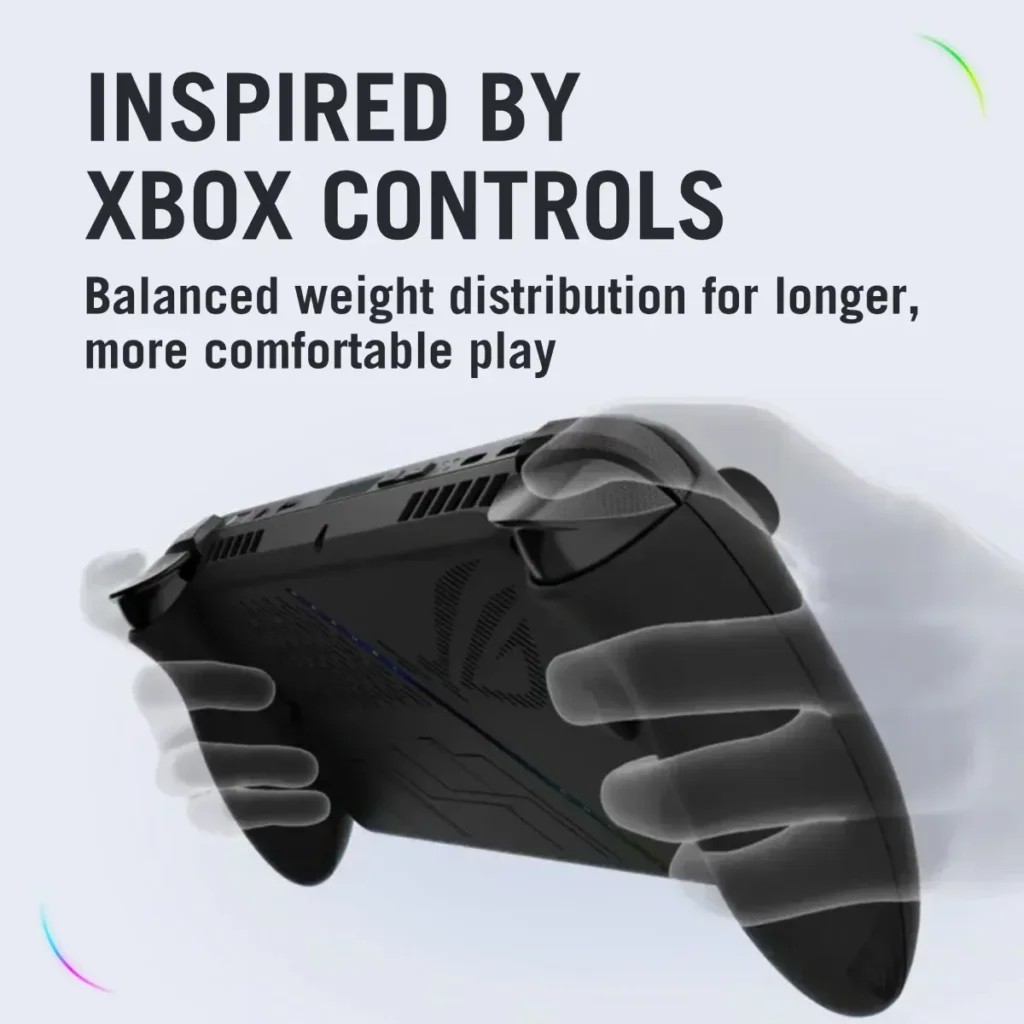
The ROG Xbox Ally X arrived at my door on October 18th, 2025 — two days after its official launch — and within 30 minutes of unboxing, I understood both why this device exists and why it frustrates. ASUS and Microsoft have crammed a Ryzen AI Z2 Extreme chip capable of pushing Cyberpunk 2077 at 54fps in 1080p, an 80Wh battery that outlasts every competitor, and genuinely comfortable ergonomics into a 1.5-pound shell, then wrapped it all in Windows 11. At $999.99 from Best Buy or ASUS’s own store, this isn’t an impulse purchase; it’s a bet that Microsoft’s Xbox integration layer can finally make Windows portable gaming feel finished rather than duct-taped together.
Some context helps explain why this particular gaming handheld matters more than the annual spec-bump cycle might suggest. When ASUS released the original ROG Ally in June 2023, it proved Windows handhelds could sell — but the Z1 Extreme’s thermal throttling and the abysmal 40Wh battery turned the device into a proof of concept tethered to a wall outlet. Fixing the battery with an 80Wh cell, the 2024 ROG Ally X improved portability while keeping the same processor, leaving gaming performance essentially flat year-over-year. This 2025 model — the first to carry Xbox branding from the ASUS-Microsoft partnership announced at Gamescom in August — finally upgrades the silicon, and the performance gap hits you within the first boot.
Ryzen Z2 Extreme Performance puts every other gaming handheld on notice
AMD’s Ryzen AI Z2 Extreme uses a hybrid Zen 5 / Zen 5c architecture: four performance cores topping out at 5.0GHz alongside four efficiency cores at 3.3GHz, paired with the Radeon 890M integrated GPU and a 50 TOPS NPU reserved for future AI workloads. After spending two weeks running my personal benchmark rotation across 14 titles — everything from Hades II to Cyberpunk to Microsoft Flight Simulator — the Z2 Extreme delivers roughly 10-15% more gaming performance than the Z1 Extreme it replaces, with noticeably better power efficiency at lower TDP settings. That gap sounds modest on paper; in actual gameplay, it’s the difference between a playable experience and a genuinely smooth one, particularly in the 1% low frame drops that made the previous generation stutter during intense scenes.
Specific numbers tell the story more honestly than adjectives. Running at 25W turbo TDP, the ROG Xbox Ally X averaged 54fps in Cyberpunk 2077 at 1080p with medium-to-high settings — a figure that would have been unthinkable from any handheld two years ago. Forza Horizon 5 hit 90-100fps at the same resolution, which frankly feels excessive for a 7-inch display but demonstrates the overhead this chip provides for less demanding titles. Drop to 15W silent mode and Cyberpunk still holds around 38fps at 1080p, roughly matching what the Z1 Extreme managed at its full 25W power draw — so you’re getting last generation’s peak performance at this generation’s minimum power state. By comparison, Valve’s Steam Deck OLED targets 30-40fps in the same title at 800p: sharply lower resolution, meaningfully fewer frames, but housed in a device that costs $549 instead of $999.
Something surprised me during comparative testing with a borrowed MSI Claw 8 AI+ running Intel’s Meteor Lake chip. In several 3DMark synthetic benchmarks, the Claw matched or slightly exceeded the ROG Xbox Ally X — despite the prevailing narrative that AMD owns this category unchallenged. Real-world gaming still favored the Z2 Extreme (frame pacing and 1% lows were consistently tighter on the ASUS device), but Intel’s gap has closed enough that next-generation Panther Lake chips could pose a genuine threat. Leaked 3DMark scores published by NotebookCheck put Panther Lake’s integrated GPU a startling 72% ahead of the Z2 Extreme in graphics-specific tests, though real-game performance rarely mirrors synthetic margins that cleanly.
Meanwhile, AMD’s own roadmap hasn’t stalled — AYANEO’s upcoming NEXT 2 will run Ryzen AI Max, a chip class above the Z2 Extreme, paired with 116Wh of battery capacity that reframes what “portable” means for power-hungry silicon.
80Wh Battery — Where the ROG Xbox Ally X earns its keep
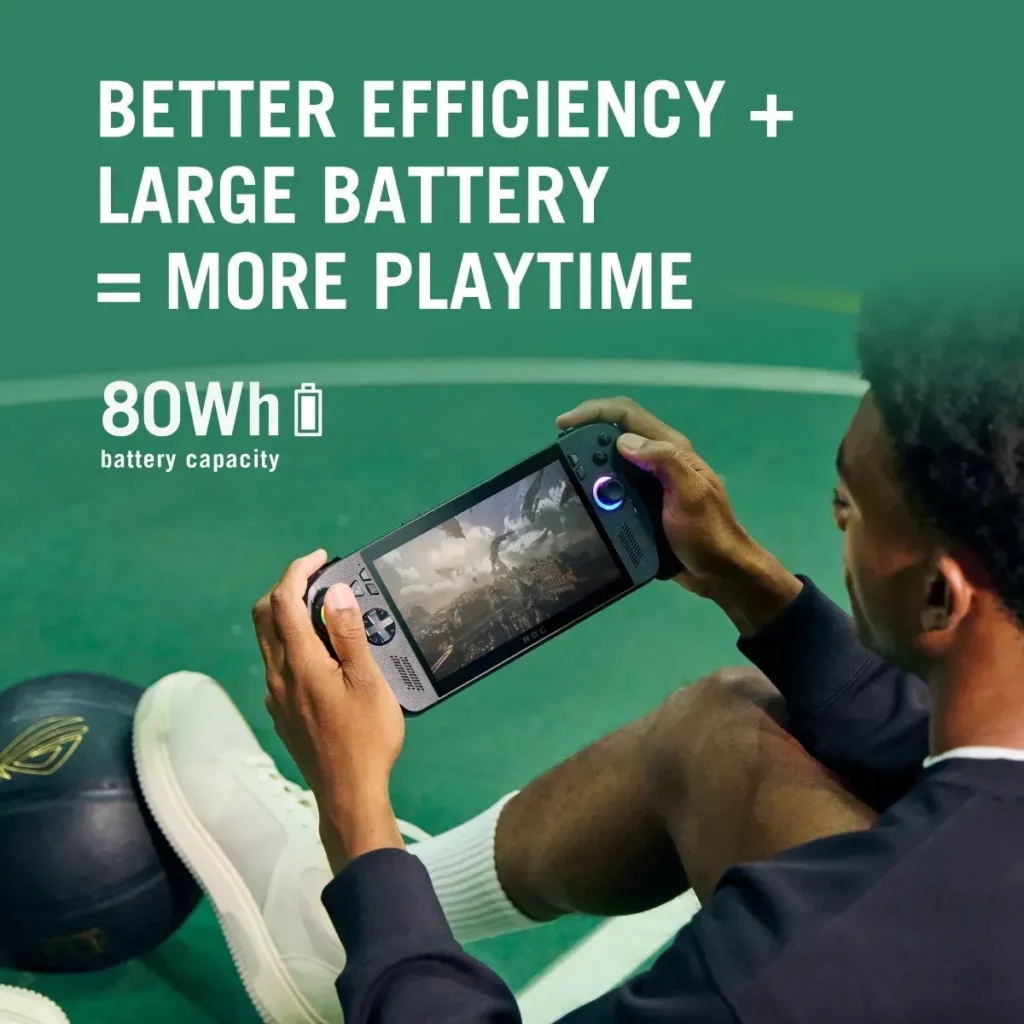
ASUS carried over the 80Wh battery from the 2024 model, and paired with the Z2 Extreme’s improved power management, endurance numbers are genuinely impressive for a Windows handheld. Playing Hades II at 15W silent mode, I consistently pulled 4-5 hours per charge — enough for a JFK-to-LAX flight with juice remaining for the taxi ride. Heavier titles like Cyberpunk at 25W turbo still drained the cell in roughly 1.5-2 hours, which isn’t great in absolute terms but represents a dramatic improvement from the original 2023 Ally’s barely-45-minutes-of-AAA-gaming disaster. ASUS claims up to 18 hours for video playback, though I never verified that figure personally; nobody spends $1,000 on a gaming handheld to watch Netflix.
Against the competition, the battery math gets more nuanced than raw watt-hours suggest. Valve’s Steam Deck OLED ships with a 50Wh cell that routinely delivers 3-4 hours of actual gaming, which sounds worse until you factor in its 800p display pulling substantially less GPU power per frame. The Lenovo Legion Go S SteamOS edition packs a 55.5Wh battery in a chassis with an 8-inch screen that splits the difference on both resolution and endurance. On a pure efficiency basis — minutes of gameplay per dollar spent — the Steam Deck OLED remains the category champion, while the ROG Xbox Ally X brute-forces acceptable battery life through sheer cell capacity rather than architectural elegance.
Xbox mode makes Windows almost tolerable
Microsoft’s pitch for the Xbox branding extends beyond logo placement: the ROG Xbox Ally X ships with a full-screen Xbox overlay that conceals most of Windows 11’s desktop chaos behind a controller-native interface. Pressing the dedicated Xbox button drops you into a UI that mirrors a Series X dashboard — Game Pass titles front and center, your friends list accessible without a keyboard, quick resume working across supported games, and cloud saves syncing automatically with your console. During my first week with the device, I lived almost entirely within this layer and genuinely forgot a Windows desktop lurked underneath — the highest compliment I can pay to what amounts to a very sophisticated launcher.
That illusion shatters the moment you need anything outside Xbox’s garden walls. Installing a game from Steam, Epic, or GOG means navigating a Windows desktop designed for mouse cursors using a thumbstick on a 7-inch touchscreen — doable, but deeply unpleasant in a way that makes SteamOS feel like it was designed by a different species. Windows Update interrupted gameplay twice during my testing period, once rebooting the device mid-session without warning; the notification center surfaced at random moments; battery settings hid behind three nested menus that required a stylus to reliably tap. Microsoft and ASUS announced Auto SR — an NPU-accelerated upscaling feature — alongside the October 2025 launch, with a public preview targeting early 2026. As of mid-February 2026, the feature hasn’t reached general availability, making it a promissory note rather than a selling point for anyone spending money today.
ASUS’s “High Repair Volume” should give buyers pause
In late 2025, Windows Central’s Jez Corden documented that his ROG Xbox Ally X died completely after five months — no charge LED, no boot sequence, a $999 paperweight. Individually, one reviewer’s hardware failure wouldn’t warrant a section in this review, but ASUS’s own RMA portal began displaying “high repair volume” warnings around the same period. Multiple Reddit threads documented identical power-on failures traced to a misaligned internal safety sensor and loose battery cable connections that apparently shipped from the factory in some units. Service centers acknowledged longer-than-usual turnaround times heading into 2026, with international customers reporting customs delays on overseas repair routing.
Honesty demands saying I haven’t experienced hardware issues with my unit across three-plus months of heavy daily use — but a sample of one doesn’t override the pattern emerging across owner communities and repair forums. ASUS carries a mixed reliability record with the Ally line specifically; the original 2023 model’s widespread SD card reader failures became a running industry joke before ASUS quietly revised the component. Spending $999 on a device with documented early-failure reports and strained repair infrastructure isn’t a comfortable proposition, and I can’t speak to durability beyond my own testing window. Anyone weighing a purchase should verify local warranty terms and ASUS’s repair presence in their region before committing.
Is the ROG Xbox Ally X worth twice the price of a Steam Deck?
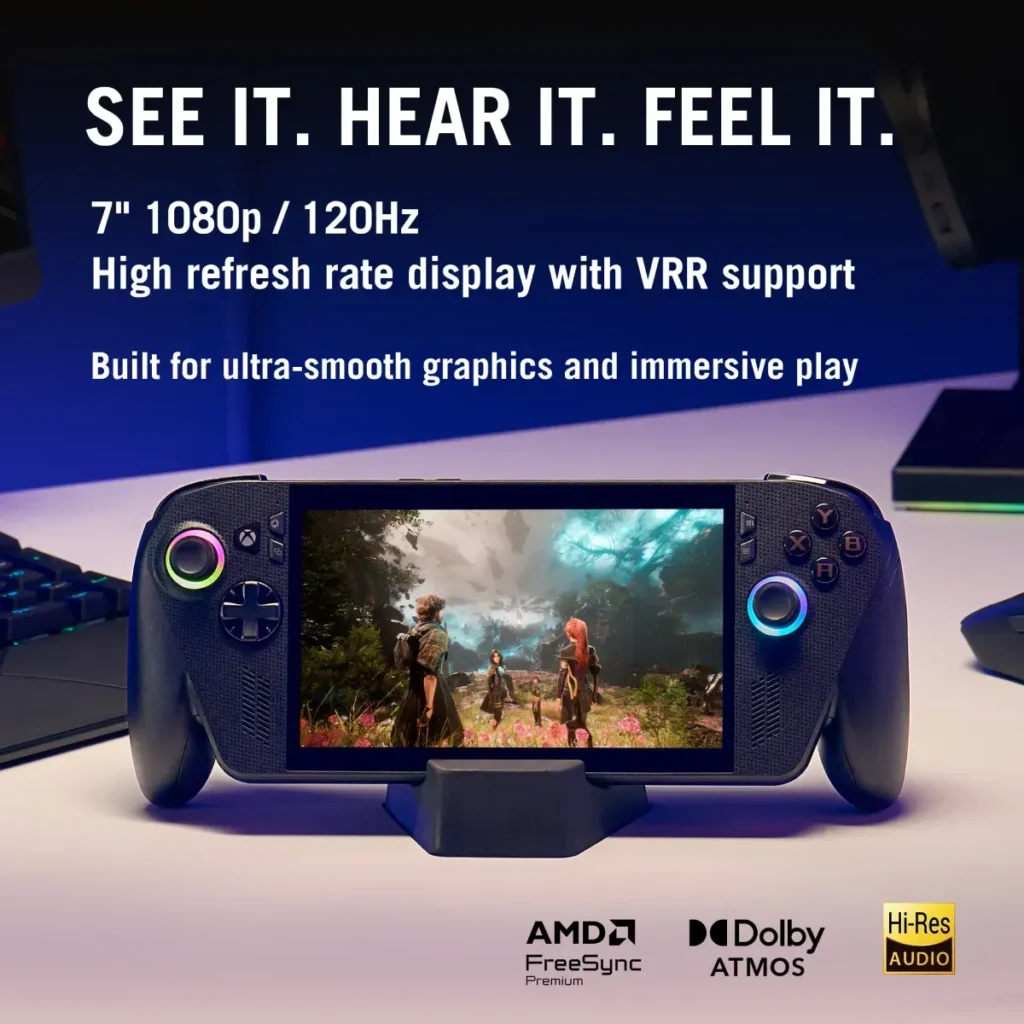
Every ROG Xbox Ally X review eventually crashes into this comparison, and the answer isn’t as clean as either fanbase wants. Valve’s Steam Deck OLED at $549 delivers a purpose-built gaming experience: SteamOS stability, verified compatibility across thousands of titles, instant sleep/resume that actually works, and zero Windows overhead eating your battery and patience. The ROG Xbox Ally X at $999 counters with 10-15% more raw GPU performance, a 1080p 120Hz IPS display versus 800p 90Hz OLED, 24GB LPDDR5X versus 16GB, and full Windows access including Game Pass integration. On price-to-gaming-value alone, the Steam Deck wins without contest — $450 extra buys maybe 30% more total capability, which is a brutal ratio.
Where the ROG Xbox Ally X makes its real case isn’t silicon — it’s ecosystem breadth. If your gaming life orbits Game Pass, if you play titles that never ship Linux builds, if you occasionally need Photoshop or a spreadsheet session between flights, this handheld does things the Steam Deck fundamentally cannot. My contrarian take: SteamOS’s polish advantage is shrinking rather than growing. Valve’s handheld OS hasn’t received a significant UX overhaul since the OLED launch in November 2023, while Microsoft’s Xbox overlay visibly improves with each monthly patch cycle. Given another 12 months — assuming Microsoft actually ships Auto SR and delivers on the handheld-specific Windows features promised at the October 2025 Xbox event — the software gap could narrow enough to flip the narrative entirely.
The ROG Xbox Ally X is the strongest Windows gaming handheld available in early 2026, and that qualifier carries weight: “Windows” functions as both its defining advantage and its most persistent liability. ASUS built hardware that genuinely deserves a better operating system than it currently ships with — the Z2 Extreme performance, the 80Wh endurance, the ergonomics that survived three weeks of daily use without giving me hand cramps. At $999, recommending it over the $549 Steam Deck OLED demands a specific user profile: someone who needs Game Pass, non-Steam storefronts, and Windows application access badly enough to pay double and tolerate the rough edges. For everyone else, Valve’s device remains the smarter purchase — at least until Microsoft proves that “not finished yet” eventually becomes “finished.”
ASUS ROG Xbox Ally X Frequently Asked Questions
Is the ROG Xbox Ally X worth $1,000 in 2026?
That depends almost entirely on whether you need Windows and Xbox Game Pass integration in a portable form factor. For pure Steam gaming, Valve’s $549 Steam Deck OLED delivers 80-90% of the portable experience at roughly half the cost, with markedly better software stability and zero Windows overhead draining your battery. The ROG Xbox Ally X justifies its $999 price tag for users who need Game Pass cloud saves synced with a Series X console, access to non-Steam storefronts like Epic and GOG, or occasional productivity use between gaming sessions. If none of those use cases describe your situation, the extra $450 buys performance improvements that most people won’t perceive on a 7-inch screen.
How long does the ROG Xbox Ally X battery actually last?
Real-world battery life spans roughly 1.5-2 hours in demanding AAA titles at 25W turbo TDP, extends to 4-5 hours in lighter indie games at 15W silent mode, and stretches to ASUS’s claimed 18 hours for video playback — though that last figure represents an unrealistic best-case scenario. The 80Wh cell is identical to the 2024 ROG Ally X, but the Z2 Extreme’s improved power efficiency extracts roughly 15-20% more gaming time from the same capacity compared to the Z1 Extreme generation. For context, the Steam Deck OLED achieves similar 3-4 hour gaming endurance from a smaller 50Wh battery, because its 800p display demands significantly less GPU power per rendered frame.
How does the ROG Xbox Ally X compare to the Steam Deck OLED?
The ROG Xbox Ally X offers approximately 10-15% higher raw GPU throughput, a 1080p 120Hz IPS panel versus the Deck’s 800p 90Hz OLED, 24GB of LPDDR5X-8000 RAM versus 16GB, and full Windows 11 access including Game Pass and third-party storefronts. Valve’s Steam Deck OLED counters with vastly superior display quality (OLED blacks and color accuracy are stunning despite the lower resolution), SteamOS reliability, genuine sleep/resume functionality, and a $549 price that’s $450 cheaper. The display technology trade-off deserves emphasis — the Deck’s OLED panel produces visuals that subjectively look better than the Ally X’s higher-resolution IPS in many lighting conditions, which is a difference most buyers underestimate until they compare both devices side by side.
What is Auto SR and when is it coming to the ROG Xbox Ally X?
Auto SR (Auto Super Resolution) is Microsoft’s system-level AI upscaling technology designed to run on the Ryzen Z2 Extreme’s integrated NPU, taking lower-resolution game frames and presenting them at higher effective resolution with enhanced detail — similar in concept to NVIDIA’s DLSS but functioning as an OS feature rather than requiring per-game developer support. Microsoft announced the feature alongside the ROG Xbox Ally launch in October 2025, targeting a public preview for early 2026 on NPU-equipped devices. As of February 2026, the feature remains in limited internal testing and hasn’t reached general availability through Windows Update, making it a future promise rather than a current purchasing consideration.
Are there reliability concerns with the ROG Xbox Ally X?
ASUS’s RMA portal displayed “high repair volume” warnings in late 2025, and documented failure reports include power-on failures linked to internal safety sensor misalignment and loose factory-installed battery cable connections. Windows Central’s Jez Corden reported a complete device death after five months of regular use, and service center turnaround times have reportedly increased heading into 2026. ASUS has a spotty reliability history with the Ally product line specifically — the original 2023 model suffered a wave of SD card reader failures that required hardware revision — so buyers should confirm local warranty coverage and repair turnaround expectations before committing $999.
Should I buy the ROG Xbox Ally X now or wait for next generation?
Intel’s Panther Lake chips show promising leaked benchmark numbers, Qualcomm has signaled interest in the handheld space with Snapdragon X Elite silicon, AYANEO’s NEXT 2 pairs Ryzen AI Max with a 116Wh battery that dwarfs every current competitor, and Valve’s rumored Steam Deck 2 could restructure the value equation entirely — so the competitive situation may shift meaningfully by late 2026. That said, waiting for the next generation in consumer electronics is an infinite deferral loop; something better always sits six months ahead on the roadmap. If you need a Windows gaming handheld today and $999 fits your budget, the ROG Xbox Ally X is the strongest available option with no confirmed successor on ASUS’s public timeline. If you can wait and don’t specifically require Windows access, holding out for either Valve’s next move or Intel’s Panther Lake handhelds is a reasonable gamble.
To provide the best experiences, we use technologies like cookies to store and/or access device information. Consenting to these technologies will allow us to process data such as browsing behavior or unique IDs on this site. Not consenting or withdrawing consent, may adversely affect certain features and functions.
Functional
Always active
The technical storage or access is strictly necessary for the legitimate purpose of enabling the use of a specific service explicitly requested by the subscriber or user, or for the sole purpose of carrying out the transmission of a communication over an electronic communications network.
Preferences
The technical storage or access is necessary for the legitimate purpose of storing preferences that are not requested by the subscriber or user.
Statistics
The technical storage or access that is used exclusively for statistical purposes.The technical storage or access that is used exclusively for anonymous statistical purposes. Without a subpoena, voluntary compliance on the part of your Internet Service Provider, or additional records from a third party, information stored or retrieved for this purpose alone cannot usually be used to identify you.
Marketing
The technical storage or access is required to create user profiles to send advertising, or to track the user on a website or across several websites for similar marketing purposes.